
Practicing the mechanics of a personality assessment can make a result easier to interpret. Learning how the response scale works, checking the device, and reading the instructions can reduce confusion that is unrelated to the construct being assessed. Rehearsing which answers sound desirable is different. It can shift your responses from a description of your usual tendencies toward a planned presentation of yourself. The resulting report may then reflect a mixture of personality, current goals, self-image, and impression management. That does not automatically make the assessment useless, and it does not prove that every practiced response is dishonest. It changes the question the score can answer. Before taking the assessment, decide whether you want a private self-reflection result, a development conversation, or information used in a consequential decision. Prepare for the format, not for a preferred profile, and read any report in light of the purpose, instructions, norm group, response-validity information, and uncertainty the provider discloses.
Start by separating two kinds of practice
The important decision is not simply whether practice is allowed. It is what you are practicing. A short orientation that shows how to move through pages, use a rating scale, recover from an accidental click, or manage the time limit addresses the testing situation. It helps you answer the intended questions without being distracted by unfamiliar software or instructions. Rehearsing a set of answers because you believe the report rewards being calm, ambitious, sociable, or agreeable addresses something else: the image you want the score to convey.
These two activities can look similar from the outside. In both cases, a person may complete sample items before the real assessment. Their measurement consequences differ. The first aims to reduce what assessment guidance calls construct-irrelevant variance, meaning influences on the score that are not part of the characteristic the test intends to assess. The second deliberately adds a goal to the response process. Your answer is no longer based only on how well a statement describes you. It is also based on what answer seems useful in this situation.
The distinction matters most when the report uses self-report items about typical behavior, preferences, or reactions. Such an assessment does not observe every action you take. It uses your answers to make an inference about tendencies. If you prepare by studying the item pattern and selecting the answer that presents the strongest candidate or most balanced person, you have supplied evidence about self-presentation as well as about the target construct. That may be relevant information in a selection setting, but it is not the same evidence as an ordinary self-description.
The International Test Commission's technology-based assessment guidance supports access to practice materials, a familiar interface, and an explanation of score use. For behavioral testing, it describes the aim of preparation as helping test takers give realistic and honest responses. That is a useful boundary: practice should help you understand the task and express your answer, not teach you a hidden answer key. [Source 2]
Interpretation one: familiarization can improve the signal
Suppose an assessment asks you to rate statements on a scale from strong disagreement to strong agreement. You are unsure whether the middle option means uncertainty, neither agreement nor disagreement, or an average amount. You also do not know whether “usually” refers to the last month, your adult life, or a particular work role. A proper orientation can resolve those questions. If the assessment is digital, a practice screen can also show how to save an answer, revisit an item if permitted, and request an approved accessibility adjustment.
This kind of preparation does not tell you how to score higher. It makes the response conditions more equal and reduces avoidable mistakes. Someone who misunderstands the scale may answer a different question from the one intended. Someone who is unfamiliar with the interface may rush, omit items, or spend attention on navigation. In those cases, a better result after orientation may be a more accurate expression of the person's response, not an inflated personality profile.
There is a practical test for deciding whether a preparation activity is benign: would it still be appropriate if every test taker received it, and does it help the person answer the same construct more clearly? Examples include reading the provider's instructions, checking language and accessibility, trying a sample item that is not scored, and asking what time frame the items use. A preparation activity becomes questionable when it supplies the preferred direction of an item, identifies the traits that a decision-maker supposedly wants, or encourages a person to make all answers look favorable.
The ITC guidance also says that preparation should not give some candidates an avoidable advantage through unequal access to the testing environment. That point is especially important for online assessments. A person may need practice with the interface because of limited digital familiarity, a disability, language demands, or anxiety. Removing those barriers is not the same as coaching a person to manufacture a trait pattern. [Source 2]
Interpretation two: answer coaching can change the construct
Now consider a different exercise. Before an assessment, someone advises you to choose answers that make you look dependable, emotionally steady, flexible, and easy to work with. You review examples, memorize a strategy for ambiguous items, and adjust answers that seem too negative. The report may still produce a neat score, but the score now comes from a changed response process. It may describe the person you are trying to present in that setting rather than your typical pattern as you understand it.
Response distortion is the broad term for a systematic departure from the response the test instructions seek. Deliberate distortion for an advantage is often called faking or impression management in the research literature. These labels should be used carefully. A favorable answer can reflect a genuinely favorable self-view, a rare exception, a wish to improve, uncertainty about the item, or deliberate presentation. A high score alone cannot tell us which explanation is true.
Research does show why coached answering deserves attention. In a study of self-report personality assessment in applicant selection, Geiger, Olderbak, Sauter, and Wilhelm describe self-report questionnaires as vulnerable to unintended, unconscious, and intentional response biases. They distinguish the extent to which a person's answers are shifted from the ability to produce a convincing desired profile. Their experiments treated faking as a purposeful change in responses to achieve a goal, and their discussion notes that high-stakes instructions can make the report less purely about typical personality. This does not establish that every applicant fakes, or that every selection assessment fails. It establishes that the purpose and response instructions are part of score interpretation. [Source 0]
An earlier validation study by Stark and colleagues reached a related caution using item-response methods with the 16PF in different testing situations. The authors reported differential item and test functioning across situations and interpreted that pattern as evidence that faking can harm the construct validity of personality scales. In plain language, the same item or scale may not behave in the same way when people are answering under different motives. [Source 1]
What changes in the report when answers are rehearsed
The most immediate change is in meaning, not necessarily in the visible format. A report may still show a raw score, a standardized score, a percentile, a band, or a narrative paragraph. Those labels do not reveal whether you answered spontaneously, carefully considered each item, or followed a practiced strategy. A percentile, for example, compares a score with a specified norm group. It does not tell the reader that the score is a pure measure of stable personality, and it does not correct for coaching by itself.
Practice can also alter relationships among scales. Imagine two items that ask about taking charge and waiting for others to speak. A person who answers from recent behavior might see a role-dependent pattern: quiet in large meetings, direct in a small project group. A person rehearsing a “strong communicator” image may choose high-assertiveness answers across contexts. The report could then show a more uniform profile than the person's ordinary experience supports. That is an illustration of how item-level choices can change interpretation, not a claim about a particular instrument's scoring algorithm.
A report may contain response-validity indicators, consistency checks, or an impression-management scale. These can be useful, but their presence does not create a universal lie detector. A flagged pattern can have several explanations, including misunderstanding, unusual circumstances, a sincere but unusually positive self-view, careless responding, or deliberate presentation. Conversely, an unflagged pattern does not prove that every response was unaffected by preparation. The provider should explain what each indicator is designed to detect and what it cannot establish.
Reliability and validity answer different questions here. Reliability concerns the consistency or precision of scores under specified conditions. Validity concerns whether the evidence supports a particular interpretation or use of those scores. A reliable score can consistently reflect a practiced presentation. The score may still be unsuitable for the claim that it represents uncoached typical behavior. The Standards for Educational and Psychological Testing, published jointly by AERA, APA, and NCME, treats evidence about test-taker response processes as relevant when those processes affect the intended interpretation. It also says that claims about practice or coaching being harmless should be documented. That is why the same report should not be treated as equally informative for self-reflection, coaching, hiring, and clinical evaluation. [Source 4]
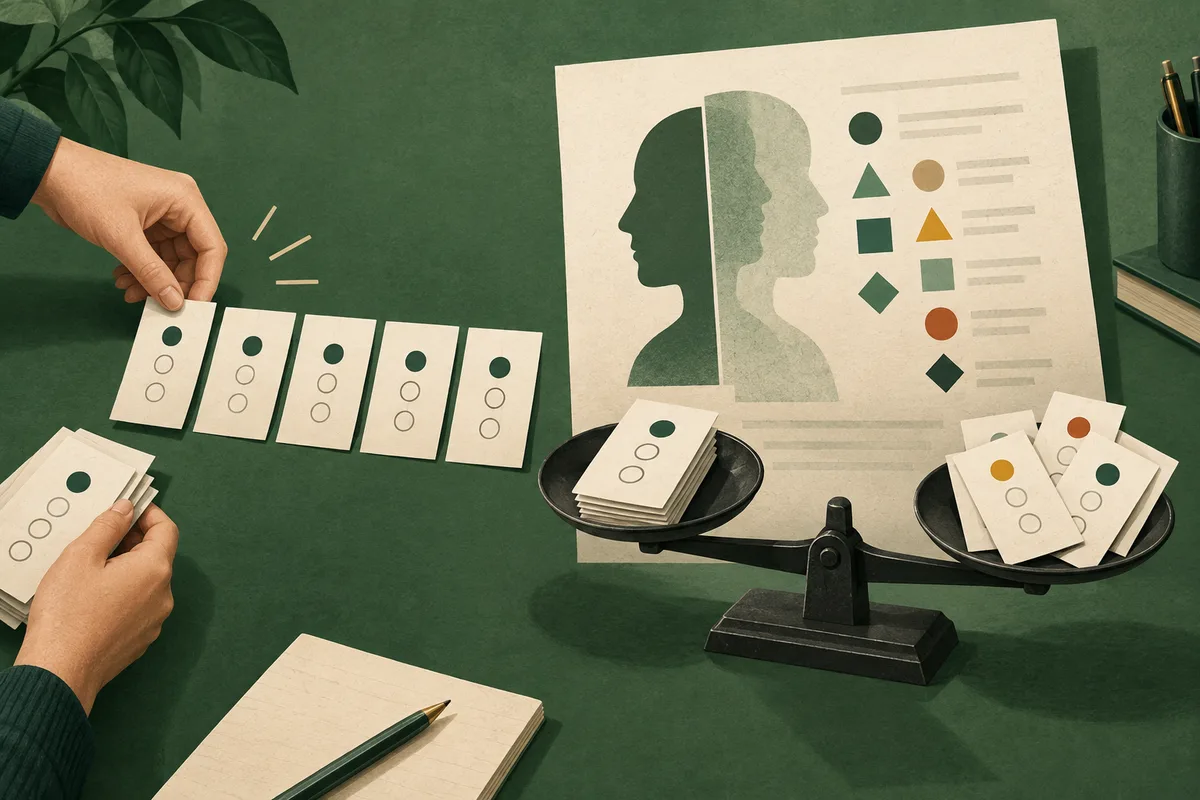
The right preparation depends on the decision
For private self-reflection, the most useful result is usually an answer you recognize as a fair description of your ordinary tendencies in the time frame named by the instructions. You may still be thoughtful. “First answer that comes to mind” is not a universal rule, and rushing can create careless data. Instead, answer each item as written, use the stated context, and resist changing an answer merely because another option sounds more admirable. If a statement does not fit across situations, note that uncertainty rather than forcing a clean identity label.
For coaching or development, the report is one input to a conversation. Tell the coach whether you took the assessment after seeing example items, whether the result was high-stakes, and whether the instructions asked about your usual self or your work self. Then test the interpretation against observable behavior: what happened in a recent meeting, how did you respond to a deadline, and what did another person actually observe? A score can prompt a useful question without settling it.
For employment selection, the stakes change the problem. A candidate may reasonably want to present strengths, yet an employer should not assume that a self-report profile is an unfiltered portrait or that one score determines suitability. The relevant questions concern the instrument's intended use, job-related validation evidence, fairness, administration, privacy, and how the result is combined with other evidence. A candidate should follow the stated instructions and avoid test-gaming. Asking the organization whether approved practice materials exist is legitimate; seeking an answer key or a strategy for defeating validity checks is not responsible assessment use.
For clinical or diagnostic decisions, a general personality report cannot substitute for a qualified assessment designed for that purpose. The article's question concerns report literacy, not diagnosis. If a report makes clinical claims without explaining its instrument, evidence, qualified interpretation, and limits, treat that as a reason to ask more questions rather than as a reason to practice its answers.
A short checklist before you begin
Use this sequence before taking an assessment or relying on its report. First, write down the decision: am I trying to understand a pattern, prepare for a coaching conversation, or participate in a consequential process? Second, read the provider's stated purpose and instructions. Look for the construct being measured, the time frame, the response scale, the intended population, and who will see the result.
Third, use only preparation that clarifies the format. Check the device, language, accessibility settings, navigation, time rules, and approved sample items. Fourth, when answering, describe your usual response in the context requested. Do not convert every item into a prediction about what an employer, coach, or report writer wants to hear. If you genuinely behave differently in two settings, record the context mentally or in your notes instead of hiding the difference.
Fifth, after receiving the report, separate what is displayed from what is inferred. Identify whether each number is raw, standardized, norm-referenced, or a band. Check the norm group and read the uncertainty or measurement-error information. Ask what evidence supports the intended use, whether response-validity information is available, and what the report cannot conclude. A result that conflicts with your experience is a prompt to investigate the instrument, context, and item interpretation, not proof that you or the report is simply wrong.
Finally, make the decision visible. If you only wanted a clearer self-reflection prompt, use the result as a hypothesis and compare it with several ordinary examples. If a coach is involved, bring the examples and discuss alternative explanations. If an organization will use the score, ask how it is interpreted, what other evidence is considered, and what happens when the result is uncertain. If those answers are missing, pause before treating the report as a verdict. You can continue building assessment literacy in the live [Personality Report topics library](/topics).
Questions readers ask
Is it wrong to practice before taking a personality assessment?
No. Practicing the interface, reading instructions, checking accessibility, and trying approved sample items can reduce confusion and anxiety. The risk begins when practice becomes coaching for desirable answers or a strategy to produce a preferred profile. Prepare for the task, then answer the assessment as instructed.
Can a personality report detect that I practiced my answers?
Some assessments include response-validity or consistency indicators, but no general indicator should be treated as a universal lie detector. A flagged pattern can have several explanations, and an unflagged pattern does not prove that preparation had no effect. Ask the provider what its indicators measure and how they affect interpretation.
What should I do if my report seems unlike me after a high-stakes assessment?
Check the assessment's purpose, instructions, norm group, score type, and any response-validity information. Note the context in which you answered and compare the interpretation with specific recent behavior. If the result will affect work or coaching, ask the responsible professional how uncertainty and other evidence are handled before accepting the report as a conclusion.
Sources and notes
- The “g” in Faking: Doublethink the Validity of Personality Self-Report Measures for Applicant Selection
Supports the distinction between honest self-report and purposeful faking, and explains how high-stakes response goals can affect personality-score interpretation.
- Effects of the Testing Situation on Item Responding: Cause for Concern
Reports evidence that item and scale functioning can differ across testing situations, raising construct-validity concerns when responses are distorted.
- Guidelines for Technology-Based Assessment: Global Testing Considerations
Supports fair access to practice, interface familiarization, clear score-use information, and realistic honest responding in behavioral testing.
- Personality Assessment Across Selection and Development Contexts: Insights into Response Distortion
Supports comparing responses across higher- and lower-motivation contexts and cautions that assessment purpose affects interpretation.
- The Standards for Educational and Psychological Testing
Supports examining test-taker response processes and documenting whether practice or coaching can change performance before making score-use claims.
Apply it to your work
Understand how you work before you choose what comes next.
From this guide: Carry this report-reading question into the work decision in front of you.
Build a private Work Pattern Report across ten workplace continuums, then compare the result with the demands of the role or environment in front of you.