
A testing accommodation is less likely to change a personality report's meaning when it removes an irrelevant barrier without changing what the items ask, how the person can answer, how responses are scored, or the comparison group behind the report. Examples may include larger text, compatible screen access, reduced visual distraction, breaks, or a format that makes the same questions accessible. The risk is higher when the change supplies information, changes the wording or meaning of items, introduces another person's interpretation, alters the response options, or affects a feature the assessment was designed to measure. Extra time deserves a closer look when speed is part of the instrument's stated construct or when the report's norms assume a fixed time limit. The decisive question is not whether the accommodated score moved. It is whether the same intended personality construct was measured with comparable precision and whether the report explains the conditions well enough to support its claim. If that evidence is missing, treat the result as useful descriptive information at most, not as a precise basis for ranking, selection, or diagnosis.
Start with the decision the report is meant to support
Suppose a report is being used to choose a coaching goal, understand a work preference, or discuss how someone approaches routine decisions. The first question is not whether the person tested under standard conditions. It is what conclusion the report is being asked to support and what the assessment claims to measure.
A short self-report about preferences is different from a timed exercise, a clinical evaluation, or a selection procedure. An accommodation that is plainly irrelevant to one instrument can matter to another. A quiet room may remove distraction from a questionnaire about work habits. It could also change the situation in a task deliberately designed to observe behavior under interruption. The same label, such as extra time or an alternate format, does not settle the interpretation.
This article uses accommodation in the technical sense of a change in presentation, administration, response, timing, or setting intended to preserve the construct being measured. A modification is a change that may alter that construct. The distinction is useful, but it cannot be decided from the accommodation's name alone.
The preservation test: what must stay the same
The most useful check has four parts. First, the item content should remain the same in substance. Second, the response should still come from the person taking the assessment, without another person explaining what an item means. Third, scoring should follow the instrument's documented rules. Fourth, the score should be interpreted against a comparison group that fits the accommodated administration and the person's context.
The Standards for Educational and Psychological Testing describe fairness as a validity issue and treat accessibility as an opportunity to demonstrate standing on the measured construct. The National Academies frames the same problem as two questions: do the versions measure the same construct, and are they comparable in difficulty and precision? Those questions transfer well to personality reports even though much accommodation research has focused on educational tests.
An accommodation can therefore improve meaning rather than weaken it. If small print prevents a person from reading a questionnaire accurately, magnification may reduce an irrelevant visual barrier. The resulting answers may better reflect the person's intended responses. A large change in the score after access improves is not, by itself, proof that the accommodation distorted the result.
A worked comparison of common accommodations
Consider a nonclinical personality questionnaire in which a person rates statements about ordinary habits on a five-point response scale. The report uses those responses to describe broad tendencies. This comparison shows how to reason about several possible changes.
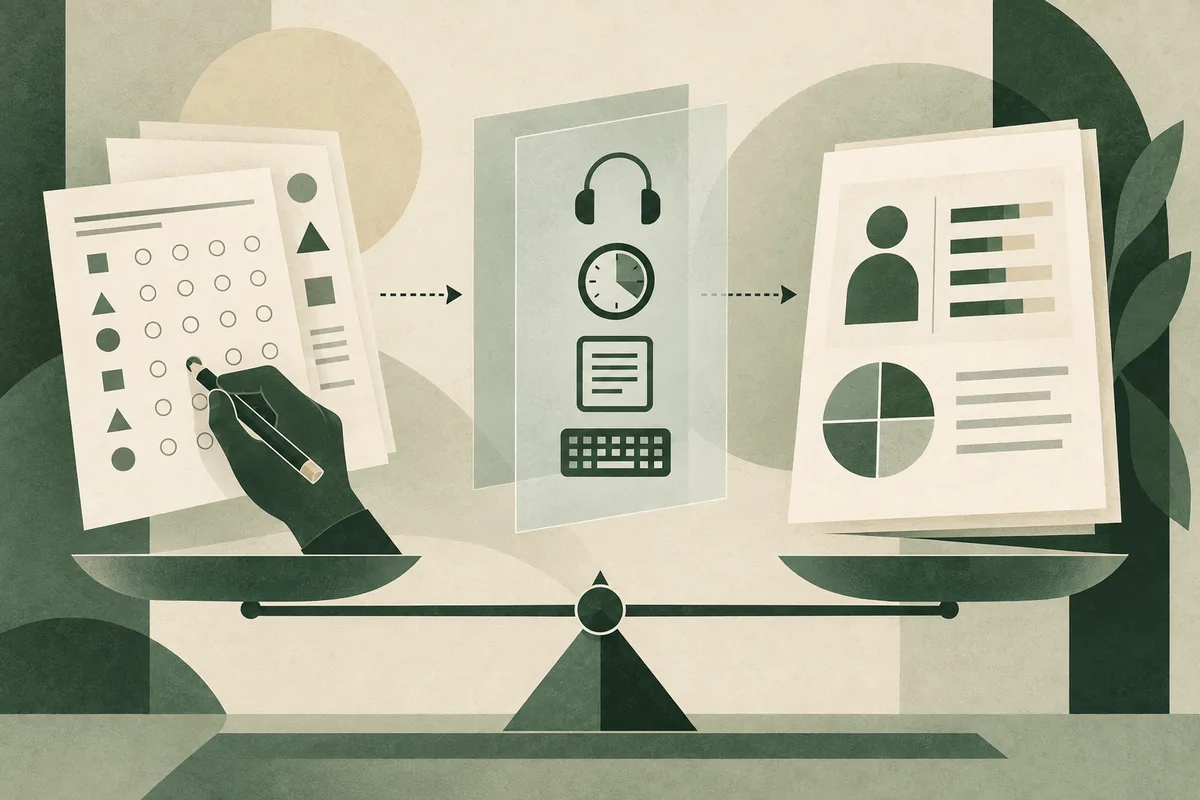
Larger text, screen magnification, keyboard access, or compatible assistive technology will often have a low interpretive risk if the wording, response choices, and scoring remain unchanged. A separate room or reduced visual distraction may also preserve meaning when the standard setting is an irrelevant obstacle rather than part of the construct.
Scheduled breaks are more context-dependent. They may help a person sustain attention across a long questionnaire, but the report should record whether the assessment permits breaks and whether responses after a break remain part of the same administration. Extra time is usually less concerning for an untimed preference questionnaire than for an instrument that explicitly measures speed, consistency under a time limit, or performance in a constrained interval.
A reader or interpreter requires careful boundaries. Reading the exact item aloud may preserve content for someone who cannot access print. Paraphrasing, explaining an ambiguous phrase, suggesting a response, or translating without validated language procedures can add another person's judgment. A scribe may record a selected answer while leaving the choice to the respondent, but the report should make clear what was done and whether the instrument's manual permits it.
When presentation changes can affect the construct
Presentation is not always a neutral wrapper. If an assessment asks about reading-related behavior, comprehension of nuanced wording, or reactions to social cues delivered in a particular format, changing the presentation may affect the thing being assessed. Even then, the conclusion should be specific. It is not enough to say that an accommodation invalidates the whole report.
The National Center on Educational Outcomes gives a clear analogy from reading assessments: reading aloud may be appropriate when reading is not the target skill, but controversial when the assessment is intended to measure reading itself. The content and purpose of the test drive the judgment. A personality questionnaire that asks a person to endorse statements about patience is not automatically equivalent to a performance task that observes patience while instructions are delivered orally.
Ask which skill the barrier affects and which construct the report claims to describe. If the barrier is unrelated, the accommodation may improve access. If the barrier overlaps the construct, the report may need a different instrument, a qualified interpretation, or a separate statement that the usual score meaning does not apply.
Why extra time needs a separate question
Extra time often sounds like a simple fairness adjustment, but its meaning depends on the instrument. Many personality questionnaires are designed to collect considered self-descriptions rather than measure how quickly someone can choose an answer. For those instruments, a fixed time limit may be an administration convenience rather than part of the construct. That still needs confirmation from the manual.
If the assessment uses timed sections, reaction speed, rapid comparisons, or a time-based response-validity rule, extra time can change the task. It may allow more reflection, checking, or revision than the standard administration. The report should state whether the score is comparable, whether a special scoring rule applies, and whether the interpretation is limited to descriptive use.
Research in other testing contexts shows why intuition is not enough. NCEO's review found that accommodation effects varied by the content being assessed and that findings for read-aloud and extended-time procedures were not uniform. This does not establish a personality-specific effect. It establishes a better habit: ask for evidence tied to the instrument and its purpose rather than importing a general rule from another test.
Response assistance can change whose judgment is recorded
A personality report normally presents answers as the respondent's self-description. That makes response assistance especially important. A person may use speech-to-text, a switch, a keyboard, or a scribe and still choose every answer independently. In that case, the physical method of recording is not necessarily the psychological content of the response.
The boundary changes when someone explains an item, chooses between interpretations, recommends a rating, or converts a vague answer into a forced choice. Those actions can introduce construct-irrelevant help, but they can also make the response impossible to attribute cleanly to the respondent. The right response is not to assume misconduct. It is to document the procedure and limit claims to what the procedure supports.
For a report reader, useful questions are: Who selected each answer? Were items read verbatim? Was translation used, and was that version supported by evidence? Did the assessor pause or rephrase? Did the software change the response scale? If the provider cannot answer, confidence should fall even if the final profile sounds plausible.
Scoring, norms, and report language still matter
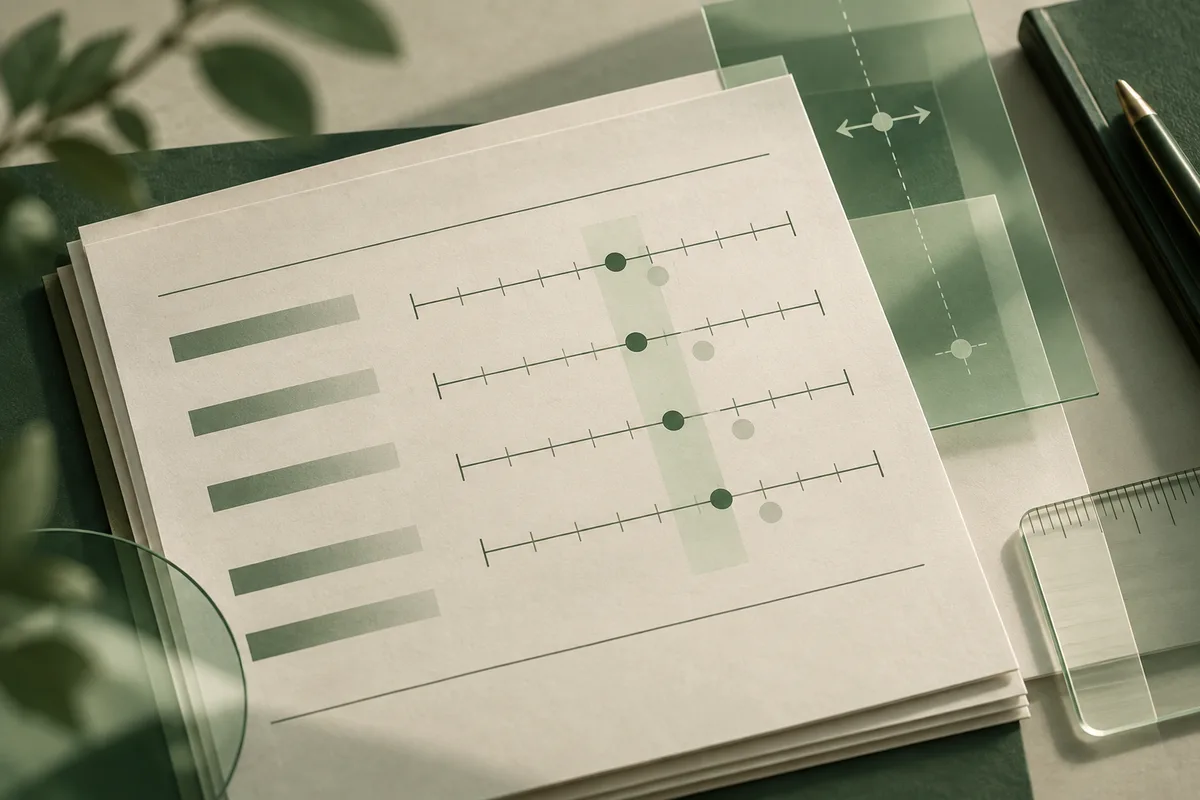
An accommodation may be well chosen while the report remains poorly interpretable. Check whether the provider used the standard scoring algorithm, handled omitted answers according to the manual, and compared the result with an appropriate norm group. A percentile is meaningful only relative to the group used to calculate it; an accommodated score does not become comparable merely because the same chart is displayed.
Look for a statement about the administration conditions. It should identify the accommodation in neutral terms, explain whether the instrument has evidence for that condition, and state any limits on comparison. A report should not mark a score as suspect simply because an accommodation was used. U.S. Department of Justice guidance says accommodated scores should be reported in the same way as other scores and should not be flagged as invalid or undeserved.
That legal guidance does not mean every interpretation is automatically supported. Reporting and interpretation are separate questions. A provider can report a score without claiming that every fine-grained conclusion, employment prediction, or comparison with an unaccommodated sample is justified.
A changed score is a clue, not a verdict
Readers often focus on whether an accommodation raised or lowered a result. That is understandable, but score movement has several possible explanations. Better access may allow more accurate responding. A changed pace may allow more reflection. A different setting may reduce distraction. The first administration may also have included ordinary measurement error or temporary fatigue.
A score difference becomes more informative when it is linked to a documented feature of the test. For example, if the manual says speed affects a scale and the accommodation removes the time limit, the two results may answer different questions. If the manual says the questionnaire is untimed and the accommodation only enlarges the text, a score change may indicate that the first administration was less accessible. Neither inference can be made from the number alone.
Avoid turning the higher score into the true self and the lower score into the impaired self. Personality reports describe tendencies through a particular measurement process. They do not reveal an untouched essence behind every answer.

The purpose changes how much uncertainty is acceptable
For private reflection, an accommodated report may help someone notice patterns, choose questions for discussion, or identify situations worth observing. The reader can hold the description lightly and compare it with repeated examples from daily life. A single result should not become a fixed identity label.
Coaching requires a clear agreement about what the report can and cannot do. It may support a conversation about preferences or work conditions, but it should not be treated as a diagnosis or as proof that a person will behave in a particular way. The coach should know the administration conditions before using narrow score distinctions to set goals.
Employment selection raises the standard further. The assessment must be job-related, used for a defined purpose, and administered in a way that does not measure a disability-related barrier instead of the intended attribute. In the United States, EEOC guidance distinguishes nonmedical psychological tests from tests that provide evidence identifying a mental disorder, and it separately addresses reasonable accommodation in the hiring process. Laws differ by jurisdiction, so a provider or employer should obtain qualified legal and assessment advice for a real case.
A practical report-reading checklist
Before relying on an accommodated personality report, write down the decision it will inform and work through these checks.
1. Identify the instrument's stated construct and purpose. Is it a self-report of tendencies, a timed task, a clinical assessment, or a selection measure? 2. Name the accommodation precisely. Do not settle for a label such as accessible format. 3. Ask what changed in presentation, setting, timing, response, scoring, and norm comparison. 4. Confirm that the respondent selected the answers and that any reader, interpreter, or scribe followed a defined procedure. 5. Check whether the manual or validation evidence addresses the accommodation for this instrument and population. 6. Read the report's limitations and administration notes before interpreting a facet or percentile. 7. Match the conclusion to the purpose: reflection permits exploratory use; high-stakes decisions require stronger, purpose-specific evidence and procedural safeguards.
If the provider cannot explain the accommodation's effect, ask for a qualified review or use a more accessible instrument whose standard administration fits the person's needs. Do not try to recreate a score by guessing how much an accommodation changed it.
A sensible decision can usually be made in three steps. First, obtain the instrument's manual or technical notes and mark the exact feature the accommodation changed. Second, ask the report provider to state whether the same construct, scoring rules, and comparison basis still apply. Third, choose one proportionate use for the result, such as a reflection question or a coaching discussion, and record what you actually observe afterward.
If the accommodation only removes an irrelevant access barrier and the provider supports the standard interpretation, the report may be read in the ordinary cautious way. If it changes content, response assistance, timing that the test measures, or the basis of comparison, pause before treating the score as equivalent. The clear decision point is whether the evidence supports the claim you want to make. If it does not, keep the report as a prompt for inquiry, not a verdict about the person.
Sources and notes
- ADA Requirements: Testing Accommodations
Supports the distinction between accessible testing, score reporting, and prohibited flagging of accommodated scores.
- Standards for Educational and Psychological Testing
Supports fairness as a validity issue and accessibility as access to the intended construct.
- Available Research on the Effects of Accommodations on Validity
Supports checking construct equivalence, difficulty, and precision across accommodated administrations.
- Accommodations for State Reading Assessments: Policies Across the Nation
Supports the point that accommodation effects depend on test content and purpose and that evidence can vary.
- Guidelines for Assessment and Intervention with Persons with Disabilities
Supports describing accommodations as changes intended not to alter the measured construct and distinguishing modifications.
- Enforcement Guidance: Preemployment Disability-Related Questions and Medical Examinations
Supports the employment context distinction between nonmedical psychological tests and tests identifying mental disorders.
Apply it to your work
Understand how you work before you choose what comes next.
From this guide: Carry this report-reading question into the work decision in front of you.
Build a private Work Pattern Report across ten workplace continuums, then compare the result with the demands of the role or environment in front of you.