
An informant personality report can add information about how a person's usual tendencies appear to someone who knows them. A self-report captures the person's private perspective, intentions, and experiences. An informant report captures behavior that is visible in a relationship or setting. The useful question is not which report is the truth. It is whether the two perspectives converge, where they differ, and whether the difference fits the purpose of the assessment. Informants are most useful when they have enough relevant contact, rate the same construct with clear instructions, and are not being asked to make a high-stakes judgment beyond the report's evidence. A disagreement can identify context, visibility, or interpretation differences. It cannot, by itself, prove that either person is biased, dishonest, or mistaken.
Start with the decision behind the extra report
Suppose a report asks whether you want to add a response from a partner, friend, colleague, or family member. Before inviting anyone, name the decision the extra information is meant to improve. Are you trying to understand a recurring interaction, prepare for coaching, compare your private view with your public behavior, or support a workplace development conversation? Each aim changes what counts as useful evidence.
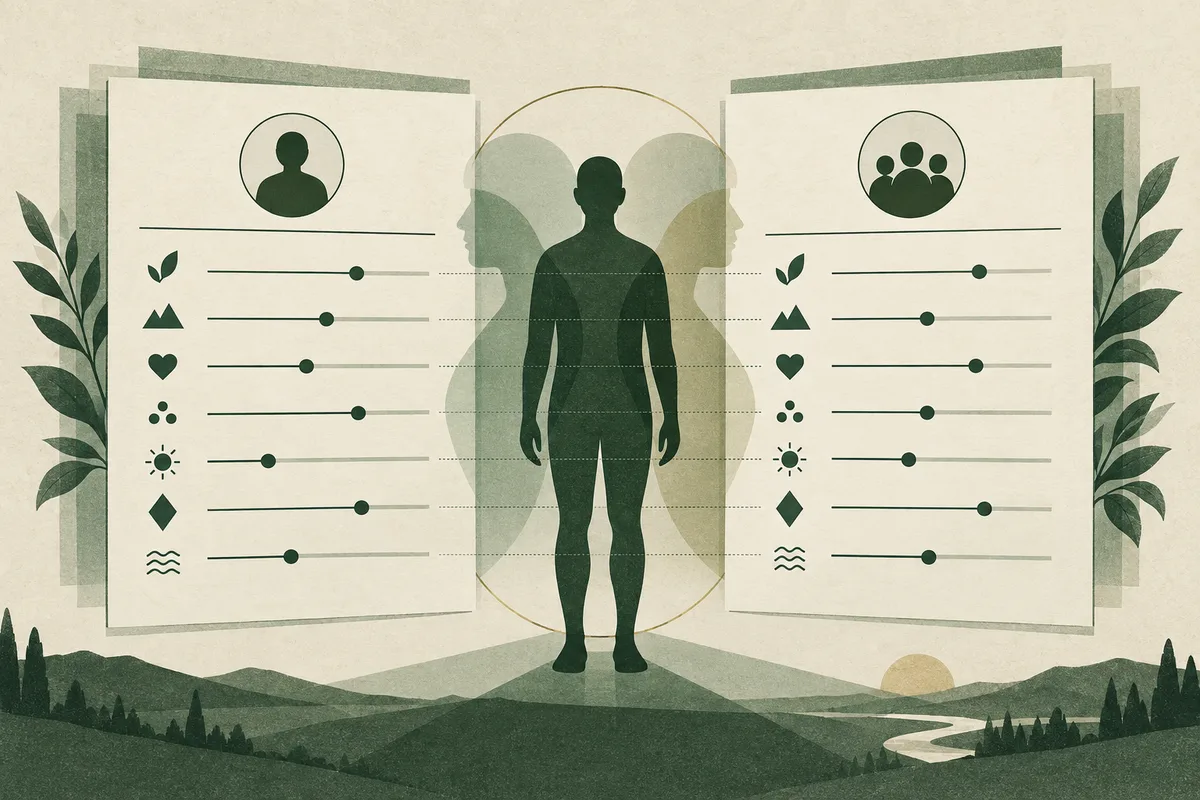
A self-report and an informant report are not two cameras pointed at exactly the same scene. The self-report gives access to thoughts, motives, private reactions, and situations an observer never sees. The informant report gives access to repeated actions, conversational habits, and effects on another person. If the question concerns an internal experience, an informant may have little direct evidence. If it concerns how often you interrupt, organize shared work, or withdraw from discussion, an informed observer may add a relevant angle.
The assessment should state what the informant is rating, how the form is worded, and how the result will be interpreted. The testing standards emphasize that score meaning belongs to a specified interpretation and use, rather than to a test name alone.
Model one: what self-report can show
Self-report is not merely a collection of opinions. It is often the most direct way to ask about behavior across situations, private feelings, and the meaning a person gives to an event. You know whether you rehearsed a difficult conversation for hours, whether a busy room felt energizing or draining, and whether a missed deadline reflected distraction, competing demands, or a deliberate change of priority. An observer may see only the final action.
That access has limits. Memory can be selective, questions can be understood differently than intended, and people can answer in ways shaped by self-protection or by the wish to present themselves favorably. Those possibilities do not make a self-report invalid. A 2019 meta-analysis comparing self-report and informant-report means found no general difference suggesting that people always describe themselves more positively. Its result is a reason to avoid the easy story that informants simply remove self-report bias.
For interpretation, read the self-report as evidence about the person's perspective on the measured tendency. It may be especially informative for private or subjective content. It should not be stretched into a promise about behavior in every setting, and a high or low description should not be treated as a diagnosis.
Model two: what an informant can add
An informant is another person who completes items about the target of the report. The added value is a second vantage point, not a supernatural reading of character. Someone who regularly works with you may observe planning, follow-through, turn-taking, or responses to disagreement. Someone close to you may see patterns across ordinary routines that do not appear in a short testing session.
The strongest addition is often behavioral visibility. Research on self-other agreement finds that traits with clearer, more frequent behavioral expressions tend to produce more agreement than private, subjective characteristics. This means an informant may contribute more to a question about observable sociability than to a question about an unspoken worry. The distinction is about access to information, not about one trait being more important than another.
Knowledge also matters. A 2010 meta-analysis of observer accuracy reported that frequent interaction improved accuracy, while interpersonal intimacy was needed for substantial increases in other-rating accuracy. That finding does not license a general rule that a spouse is always a better rater than a colleague. It means the relationship should fit the behavior being judged and provide enough relevant observation.
A worked comparison without choosing a winner
Imagine a report about cooperation. The self-report suggests that the person usually listens carefully and prefers to resolve disagreement privately. An informant who often works with them reports that, in meetings, they move quickly to solutions and sometimes answer before others finish. These statements can both be accurate. The first describes an intention or a pattern the person notices in close conversations. The second describes a visible behavior under the time pressure of meetings.
The useful interpretation is a question: in which setting does the behavior change? A follow-up conversation might ask for two recent examples, what was happening immediately before each exchange, and whether the person wants to change the meeting behavior. The informant report has added a behavioral prompt. It has not established a fixed trait, an interpersonal flaw, or a prediction of future performance.
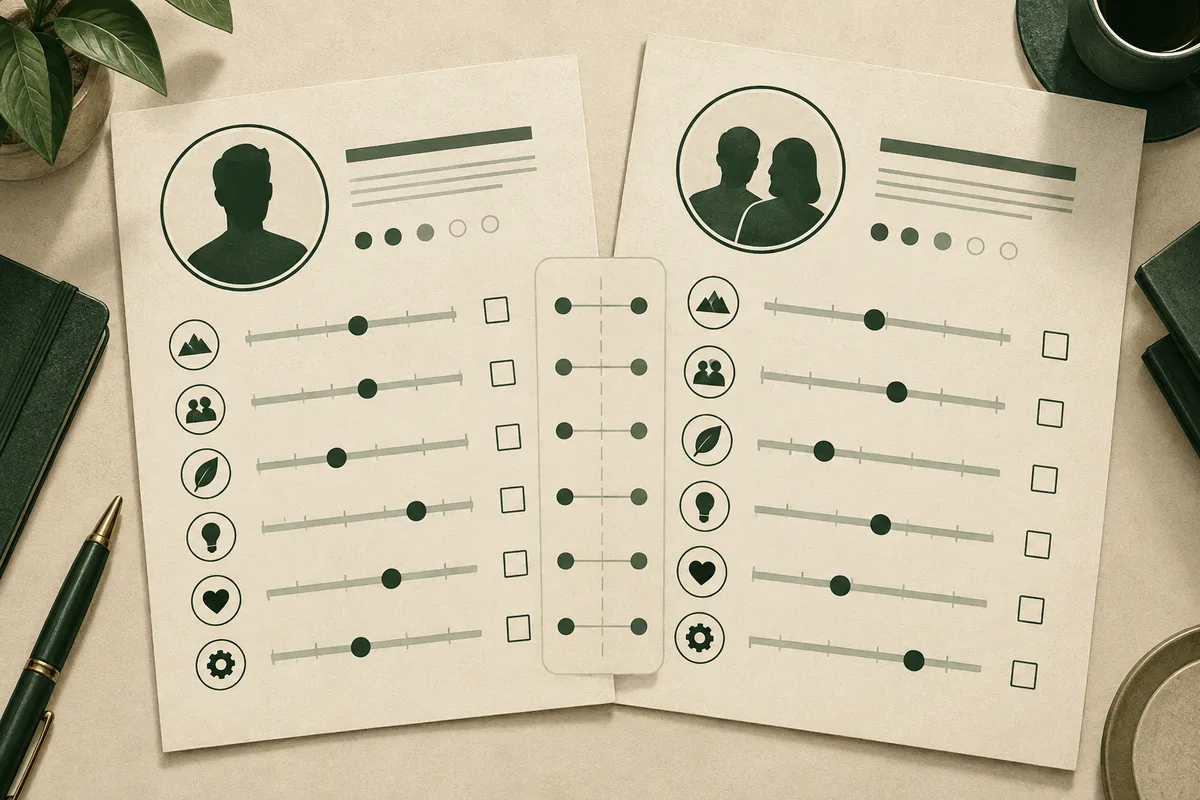
This comparison also shows why matching item content matters. If the self and informant forms use different wording, time frames, or response scales, a difference may reflect the forms rather than the people. A responsible report makes the comparison understandable and labels whether it is showing raw scores, standardized scores, percentiles, bands, or a narrative summary. Those outputs answer different questions and should not be treated as interchangeable.
Choose the informant for the behavior, not the label
The best informant is not automatically the person who loves you most, agrees with you most, or holds the most senior role. Choose someone who has repeated opportunities to observe the behavior the report addresses. For shared project habits, a colleague may have better access than a relative. For patterns at home, the reverse may be true. For private reactions, neither may have enough evidence.
Explain the purpose and the limits before asking. The informant should know whether their response will be shared, whether it will affect a decision, and whether they may decline. A report that hides the rater's identity or uses an unverified relationship may create a privacy and interpretation problem even when the scores look neat.
Be cautious with a single informant who has a conflict of interest, sees you only in one pressured setting, or is evaluating a recent disagreement. Their view may still be useful as context, but it should be framed as one perspective. The research literature shows that acquaintanceship and trait visibility affect agreement, so relationship quality and observation conditions belong in the interpretation.
Read agreement as convergence and disagreement as a question
When self-report and informant report point in the same direction, confidence in the description may increase, particularly when the forms measure the same construct and the informant has relevant knowledge. Agreement does not make the result a fact independent of measurement. Both raters may lack access to a situation, share the same misunderstanding of an item, or be influenced by the same context.
Agreement is also more informative when it is specific. “You are difficult” is a broad judgment. “In the last three project meetings, you asked for a decision before the discussion had closed” points toward an observable behavior that can be checked and discussed. A good report translates broad scale language into careful examples without pretending that one example represents the whole person.
A 1995 study of personality judgments found better self-other agreement for acquaintances than for strangers. The practical lesson is modest: familiarity can improve the basis for a judgment, but it does not guarantee fairness or accuracy. Ask what the rater has actually seen before giving agreement more weight.
A gap between reports is not a failed assessment. It can reflect different settings, different time frames, different standards, or a tendency that is visible to one person and private to the other. It can also reflect a rater's expectations or a measurement problem. Treat the gap as a hypothesis, then look for concrete observations that could support or weaken each explanation.
Start with four checks. Did both forms ask about the same period? Did the informant have enough contact? Is the behavior observable? Could the relationship create pressure to flatter, criticize, or protect? If the answer to several checks is no, the report should lower the weight placed on the comparison rather than invent a psychological explanation.
The self-other knowledge asymmetry model proposes that people and observers can know different aspects of personality because they have different information and motivations. This is a useful interpretive frame, not a machine for deciding who is right. A difference may be a real context distinction. It may also be ordinary disagreement. The score alone cannot tell you which.
Decide whether one informant is enough
If the report is for reflection or coaching, one well-chosen informant can provide a focused prompt. If the decision concerns a broad pattern across settings, several independent informants may offer a more balanced view. Aggregating ratings can reduce the influence of one unusual impression, but it does not solve every problem. A group can share the same context, repeat one another's assumptions, or rate a behavior none of them can observe.
The report should explain whether it averages ratings, shows them separately, or combines them into a comparison with the self-report. It should also state how missing responses are handled and whether different raters had comparable opportunities to observe the target. Without that information, a polished composite can look more precise than the evidence warrants.
The 1996 comparison by Kolar, Funder, and Colvin found that aggregated judgments from two acquaintances predicted videotaped behavioral criteria better than self-judgments in that study. That is evidence for a particular design and behavioral criterion, not a universal instruction to collect two ratings or to use informants for selection. Generalize only as far as the instrument's own evidence allows.
Keep the use proportionate to the evidence
Informant reports can be constructive in self-reflection, coaching, and development when the person receiving the report can discuss examples and retain agency over the next step. They need more scrutiny in selection, promotion, or other decisions that affect access to work. A report should show evidence for the intended use, explain relevant limitations, and consider consequences for the people being rated.
Do not use a general personality report to diagnose a condition, settle a relationship dispute, or declare someone suitable or unsuitable for a role. A rater's low score may describe limited exposure, a strained relationship, or a narrow work context. A high score may reflect warmth or familiarity rather than broad evidence. No informant format turns interpretation into certainty.
The testing standards describe validity as support for interpretations of scores for specified uses. That principle matters here: evidence that an informant rating relates to observed behavior in one study does not automatically validate a hiring decision, a clinical conclusion, or a forecast about a different outcome.
Use this report-reading checklist
Before acting on an informant comparison, ask: What construct is being measured? What does the self-report add that an observer cannot see? What behavior can the informant actually observe? How long and how closely has the informant known the person in the relevant setting? Were the forms parallel? Are the scores comparable, and is uncertainty shown? Does the report distinguish description from prediction? Is the intended use reflective, developmental, occupational, or clinical? Is that use supported by evidence? Who can see the responses, and can the informant or target decline?
Then choose one small next step. If the reports converge, use the shared pattern to identify a concrete situation to understand. If they diverge, do not argue from the score. Ask for an example, compare contexts, and decide whether the difference matters for the stated purpose. The report is most useful when it improves observation and conversation, not when it supplies a final label.
For more help reading score meaning, norms, uncertainty, and report sections, continue with the live Personality Report topics library.
Questions readers ask
Is an informant personality report more accurate than a self-report?
Not in every situation. Informants may add useful evidence about visible behavior, while self-report is usually better placed to describe private experience and intentions. Accuracy depends on the construct, the setting, the relationship, and the evidence for the intended use.
Who should complete an informant personality report?
Choose someone with repeated, relevant opportunities to observe the behavior being assessed. A colleague may fit workplace behavior, while a close person may fit home routines. Do not assume that familiarity alone makes a rater unbiased or fully informed.
What should I do if the self-report and informant report disagree?
Check whether the forms, time frames, settings, and observed behaviors match. Then treat the difference as a question to investigate with concrete examples. It does not prove that either person is dishonest, biased, or wrong.
Sources and notes
- Standards for Educational and Psychological Testing
Supports matching score interpretations, normative information, reliability, fairness, and consequences to a specified intended use.
- An Other Perspective on Personality: Meta-Analytic Integration of Observers’ Accuracy and Predictive Validity
Supports the role of interaction frequency and interpersonal intimacy in observer-rating accuracy and the value of other-ratings.
- Self-Other Agreement in Personality Reports: A Meta-Analytic Comparison of Self- and Informant-Report Means
Supports the finding that self-report means did not generally differ from informant-report means in the meta-analysis.
- Who knows what about a person? The self-other knowledge asymmetry model
Supports the framework that self and observers can know different personality aspects because their information and motivations differ.
- Agreement among judges of personality: Interpersonal relations, similarity, and acquaintanceship
Supports better self-other agreement among acquaintances than strangers in the reported personality-judgment studies.
- Comparing the Accuracy of Personality Judgments by the Self and Knowledgeable Others
Supports the study-specific finding that aggregated judgments from two acquaintances predicted videotaped behavioral criteria better than self-judgments.
Apply it to your work
Understand how you work before you choose what comes next.
From this guide: Carry this report-reading question into the work decision in front of you.
Build a private Work Pattern Report across ten workplace continuums, then compare the result with the demands of the role or environment in front of you.