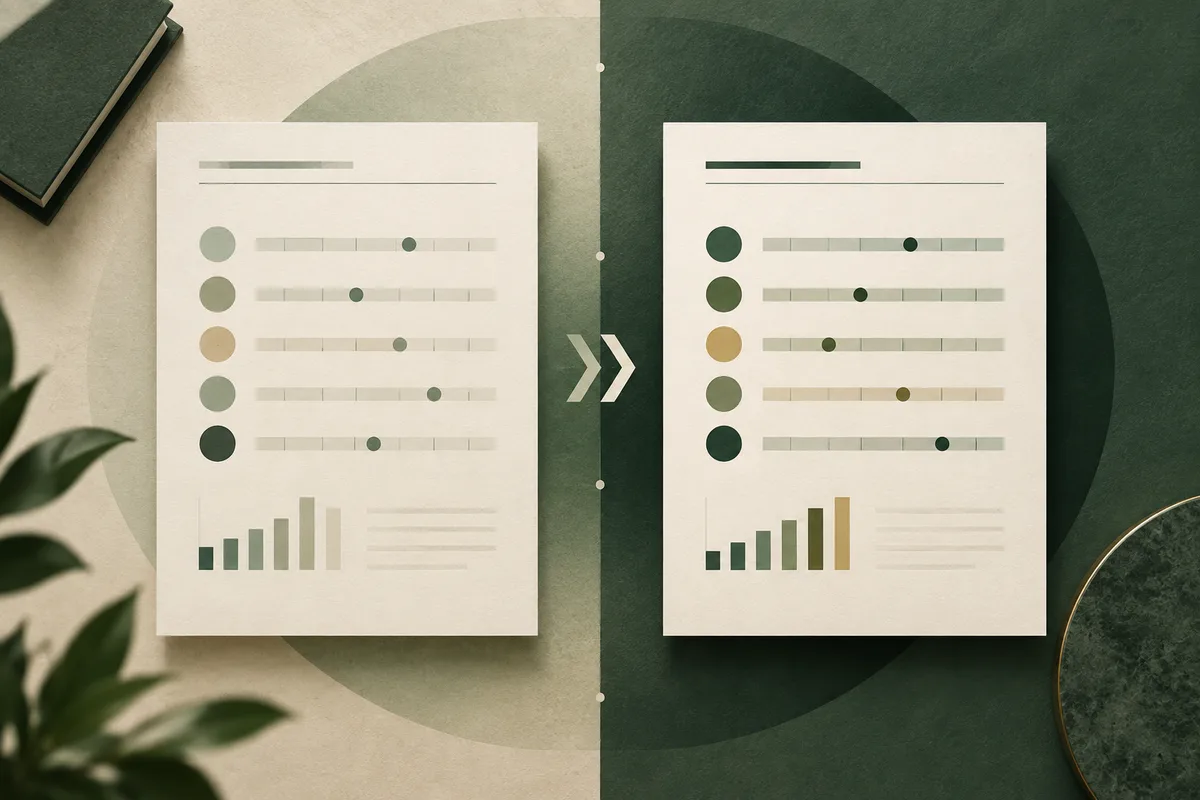
The 2024 NEO-PI-3 Normative Update changes the reference sample used to interpret scores and adds optional response-validity scales; its publisher says the items and scoring are unchanged. You can compare an older report with a current one only after identifying whether the original responses were rescored or the person completed the inventory again, and which norm groups and report forms were used. The publisher allows legacy response data to be entered for an updated report, but that operational option does not establish that scores under the two norm editions are numerically interchangeable. Treat the older report as a dated interpretation, not as proof that a person has changed or that either result is wrong.
What changed in the 2024 NEO-PI-3 update?
The update changes the comparison reference, not the questionnaire content, according to publisher PAR. A norm is the reference distribution used to interpret a person's score relative to a defined group. PAR says the 2024 Normative Update uses data collected in 2024: 1,855 people aged 12 and older on the Self-Report Form and 1,200 on the Informant Report Form. It describes the sample as representative of the current U.S. Census. Those counts and that description are publisher-reported; the public page does not show detailed sampling, participation, weighting, or subgroup precision information needed to independently assess every comparison.
PAR says the NEO-PI-3 items and scoring have not changed. The update adds optional Positive Presentation Management and Negative Presentation Management validity scales, and offers a streamlined set of print forms and digital reporting through PARiConnect. These scales concern response presentation; their presence does not mean every profile is invalid or that the scales diagnose dishonesty. The report's form and selected options still matter when comparing results.
This is also distinct from the creation of the NEO-PI-3 itself. In the 2005 revision paper, McCrae, Costa, and Martin describe modifying the earlier NEO-PI-R after identifying items some adolescents had difficulty understanding, then testing replacements using self-report and observer data from 500 respondents aged 14 to 20. The paper reports that the modified instrument retained its intended factor structure. That earlier item revision is not what PAR describes as the 2024 normative update. So the word “updated” needs a date and version attached: a 2005 instrument revision and a 2024 norm refresh are different changes.
Sources: NEO Personality Inventory-3 (Normative Update): product details, FAQ, and technical information; The NEO-PI-3: a more readable revised NEO Personality Inventory
Can I compare an older report with a current one?
Yes, but first name which comparison you have. The cleanest comparison holds the response data constant and changes only the norm reference: the same answers are scored once using the older norms and again using the 2024 norms. PAR says an administrator can manually enter a legacy administration's data in the Normative Update system to generate an updated report. This creates a practical way to examine how one response set is described under the newer reference. Ask the administrator to confirm that the original item responses, rather than only a summary score, were used.
A second comparison is a retest: the person answers again, perhaps years later, and the new answers are interpreted using current norms. Here both the response set and possibly the norm reference have changed. A third case compares two reports without knowing whether they used the same responses, respondent form, or norm group. In that case, the score difference bundles several possible causes and cannot isolate a norm effect.
A raw score is based on the item responses; a converted score such as a T score places that result on a scale interpreted using a reference group. Same items and scoring mean the measurement procedure is largely held constant, but the relative position can still differ when the comparison distribution changes. Similar-looking numbers therefore do not automatically carry identical meaning across editions.
The joint AERA, APA, and NCME testing standards discuss describing norm populations and documenting norming studies so users can judge whether a reference group fits a proposed comparison. That general guidance helps frame the questions to ask about the norm groups in two reports. PAR's public product page offers a data-entry route but does not explain how to compare scores across norm editions. Its silence on that point does not establish that the scores are, or are not, interchangeable; check the applicable technical documentation with the administrator.
Sources: NEO Personality Inventory-3 (Normative Update): product details, FAQ, and technical information; Standards for Educational and Psychological Testing (2014)
What would make a score difference meaningful?
Before interpreting a difference, check what stayed fixed. If the same original responses were rescored and only the norm edition changed, a shift in a norm-referenced score is evidence that the description relative to the reference group changed. It is not, by itself, evidence that the person's tendencies changed. If there was a retest, the new responses may reflect enduring patterns, changing circumstances, different self-perception, or ordinary response variation; the number alone cannot separate these explanations.
The updated report's form matters too. A self-report and an informant report are different perspectives, not duplicate readings of one answer sheet. The publisher lists separate sample counts and reliability summaries for the forms. It reports internal-consistency ranges and retest coefficients, but these summaries concern score consistency in the updated sample. Reliability is not the same as score equivalence across norm editions, nor does it establish that an individual difference is meaningful. The public page does not provide enough detail to calculate a person's uncertainty from the displayed information alone.
Use this comparison check before drawing a conclusion: (1) identify the report date and edition; (2) note the norm group or comparison option printed in each report; (3) confirm self-report versus informant form; (4) establish whether the current report uses the original responses or a retest; and (5) ask what the score scale means in each version. The standards call for norm documentation that describes the sampled population, testing dates, and related technical details so users can judge fit. PAR's product page identifies the U.S. context and sample counts, but it is not a substitute for checking the full manual when subgroup fit or precision matters.
For private reflection or coaching, compare the descriptions with repeated, specific examples from daily life and note where the interpretation fits or does not. If a consequential decision depends on the difference, do not treat a norm shift as a stand-alone judgment. Ask a qualified assessment professional to explain the report versions, relevant uncertainty, and evidence for the particular use.
Sources: NEO Personality Inventory-3 (Normative Update): product details, FAQ, and technical information; Standards for Educational and Psychological Testing (2014)
What is the supported verdict for an older report?
An older NEO-PI-3 report can remain useful as a historical record of how the earlier responses were interpreted against the norms named at that time. It is not automatically useless because a newer reference exists. But a current comparison should name the norm edition, report form, and response set. Do not read a different percentile or converted score as a personality change without evidence that supports that conclusion.
The strongest reason to expect continuity is real: PAR says the items and scoring have not changed, and it provides a way to generate a Normative Update report from legacy response data. That can hold the answers steady while the reference changes. The public product page does not explain whether scores under the two norm editions can be substituted for one another, so ask the administrator to consult the technical documentation before treating them as equivalent.
A practical next step is to retrieve the report and record its date, edition, comparison group, and whether it is self- or informant-rated. Then ask the administrator whether the original responses can be rescored and request the norm group shown by each report. If the question is about a recurring work pattern rather than score equivalence, the live Work Pattern Report can help turn a broad concern into observations across decisions, planning, feedback, collaboration, and change. It is a low-stakes self-report without norms or a hiring score, so use it for reflection rather than as a job recommendation.
Verdict: compare the interpretations with care, and compare the numbers only when the report documentation supports the meaning you assign them. An older report tells you what its earlier scoring reference said about those responses; a current report can update that reference. The action that resolves most uncertainty is simple: establish whether the answers changed, or only the yardstick did.
Sources: NEO Personality Inventory-3 (Normative Update): product details, FAQ, and technical information; Standards for Educational and Psychological Testing (2014)
Sources and notes
- NEO Personality Inventory-3 (Normative Update): product details, FAQ, and technical information
PAR identifies the 2024 norm sample, sample counts, unchanged items and scoring, optional validity scales, available reliability summaries, and legacy-response re-entry process.
- Standards for Educational and Psychological Testing (2014)
The 2014 Standards discuss relevant norm populations and norm-study documentation, including details that help users judge whether norms fit an intended comparison.
- The NEO-PI-3: a more readable revised NEO Personality Inventory
The Duke research record provides the 2005 revision abstract describing adolescent item comprehension work and the study's reported sample and findings.
- Testing Standards
NCME identifies the Standards as a joint AERA, APA, and NCME publication and links to the open-access 2014 edition.
Apply it to your work
Turn a broad work-style question into specific observations
From this guide: If the report comparison leaves you asking how a recurring work pattern appears in practice, identify the situations where it helps or creates friction.
The NEO-PI-3 comparison can clarify how a score was referenced, but it cannot settle how a tendency combines with your planning, feedback, collaboration, or response to change in everyday work. The Work Pattern Report offers a low-stakes self-reflection across those continuums. Use it to form more specific questions about repeated friction, not as a hiring score or a verdict about your employability.