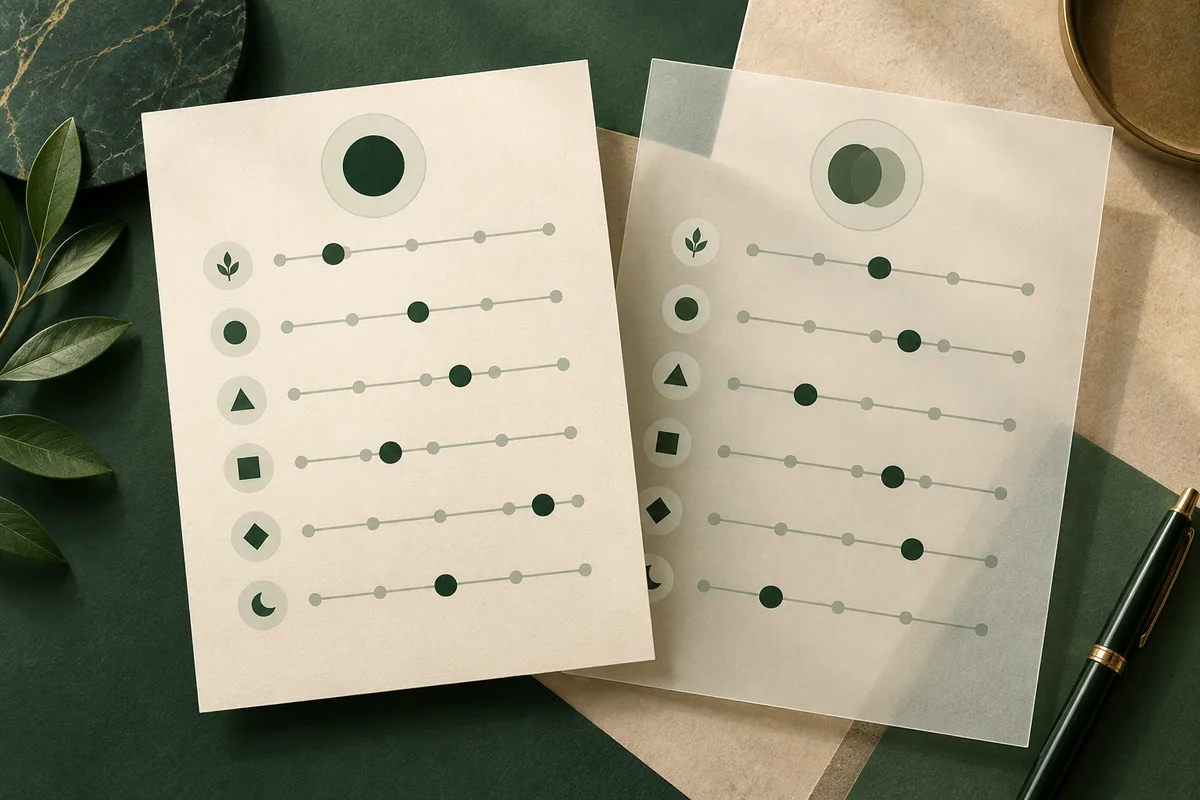
When your personality report and a close observer's rating disagree, treat the gap as a question about perspective and context, not a verdict about who knows you better. First check that both ratings use the same scale, wording, direction, and time frame. Then identify the exact behavior behind the disputed item and ask what each of you had a chance to observe. Research finds that self and observer reports can each add useful information, but average agreement across a group cannot decide which account fits one person. Look for repeated, specific examples before acting on the interpretation.
What does a self–observer gap show?
An observer rating is another person's estimate of your usual thoughts, feelings, or behavior. A self–observer gap means the two ratings differ under the conditions of the report. Alone, it does not show whether the self-rating is biased, the observer misunderstood, or the difference matters in daily life.
Before interpreting the gap, compare like with like. Are you both answering the same items, for the same time period, with the same response scale? Does a high number mean “more of the trait” in both versions? Some reports show raw totals, while others convert results against a norm group, a reference sample used to interpret scores. A self percentile and an observer raw score cannot be read as a direct disagreement. Check the report's scoring notes before treating displayed numbers as comparable.
It also helps to separate three statistical questions. A group average asks whether one source tends to give higher scores than another across many people. A correlation asks whether people rated higher by themselves also tend to be rated higher by others. Neither tells you whether two ratings for one person are close. For instance, a study can find almost no average difference between self and informant reports while individual pairs still disagree. Kim, Di Domenico, and Connelly's 2019 meta-analysis compared Big Five report means across 152 samples and 33,033 people; its near-zero average difference is evidence about group means, not a rule for resolving your own report.
So begin at the narrowest point of disagreement. Is it one example sentence, one item, a facet, or a whole scale? A broad label such as “low openness” may hide different answers to several questions. A mismatch on one item should not be enlarged into a claim about an entire personality domain. The useful first conclusion is modest: the two raters understood or observed something differently, and the report may not tell you why.
Sources: An Other Perspective on Personality: Meta-Analytic Integration of Observers' Accuracy and Predictive Validity; Self–Other Agreement in Personality Reports: A Meta-Analytic Comparison of Self- and Informant-Report Means
Why might two people give different ratings?
You and an observer do not have identical access to your behavior. You know more about private thoughts, feelings, and intentions. Someone who sees you regularly may notice actions and reactions that feel ordinary or unremarkable to you. Neither vantage point covers every setting. A friend may see how you handle plans together but not how you respond during a difficult meeting; you may know how tense you feel while the friend sees only that you stayed quiet.
Simine Vazire's self–other knowledge asymmetry model proposes that the relative value of these perspectives can shift with how visible and evaluative a trait is. In a study of 165 participants, self-ratings were more accurate on neuroticism-related traits, friends' ratings on intellect-related traits, and perspectives were similarly accurate on extraversion-related traits, judged against behavioral measures. These findings illustrate possible differences in access; they do not identify the correct rater for every trait word or commercial report.
Closeness can provide useful access, but it does not make an observer all-knowing. Connelly and Ones combined 263 samples involving 44,178 targets. Their meta-analyses found that interaction frequency was related to observer accuracy and that intimacy improved accuracy, especially for less-visible traits. They also found observer reports predicted some behavioral outcomes. These are reasons to take another person's view seriously. They are not proof that one close observer has seen every relevant situation or that their rating should overrule yours.
Ask about opportunity to observe rather than relying only on relationship labels. What situation did the observer have in mind? How often did it occur? Did the person see the behavior directly, or infer it from an outcome? Then ask yourself the same questions. This turns “you see me differently” into a more answerable comparison: perhaps both ratings refer to real patterns in different contexts, or perhaps one rating rests on a single memorable episode. Those remain hypotheses until you examine examples.
Sources: Self–Other Agreement in Personality Reports: A Meta-Analytic Comparison of Self- and Informant-Report Means; Who Knows What About a Person? The Self-Other Knowledge Asymmetry (SOKA) Model
Does a gap mean one rating is wrong?
No. A disagreement is not itself evidence that someone is inaccurate. Nor does agreement prove that a rating is accurate: two people can share a view and still miss behavior outside their experience. The strongest conclusion from the available research is that observer and self reports can carry information, while their value depends on the trait, observer, measure, and question being asked.
The 2019 meta-analysis by Kim and colleagues is sometimes easy to overread. Across its Big Five samples, self and informant mean ratings were generally similar; comparisons with strangers showed moderate differences. This challenges the simple claim that people always rate themselves more favorably than others do. But a near-zero group average can arise even when some individual self-ratings are higher and others lower. It cannot reveal which way the evidence points for your particular pair of scores.
The counterpoint matters too. Connelly and Ones found observer ratings had predictive value for some behaviors, including academic and job-performance criteria, beyond self-ratings in their synthesis. That finding makes observer reports worth considering in research and assessment. It does not establish that your observer's rating is correct, validate the personality report you used, or justify turning one person's impression into a hiring or promotion decision. Prediction in a set of studies and interpretation of an individual profile are different claims.
For the same reason, do not automatically average the two numbers, choose the harsher rating as more honest, or dismiss the observer as unfamiliar with your inner life. Averaging makes sense only if the instrument's scoring method supports it. Instead, ask what evidence would strengthen each account. If the observer cites several recent, directly seen examples and you can identify where your own view differs, the gap may reveal a context to explore. If neither of you can name examples, the report may be too broad to support an action.
Sources: An Other Perspective on Personality: Meta-Analytic Integration of Observers' Accuracy and Predictive Validity; Self–Other Agreement in Personality Reports: A Meta-Analytic Comparison of Self- and Informant-Report Means; Who Knows What About a Person? The Self-Other Knowledge Asymmetry (SOKA) Model, full text
How can I investigate one disagreement responsibly?
Use the report to frame a small inquiry. This sequence is a practical reflection method, not a validated scoring procedure:
1. Check the label, item wording, response direction, reference group, and period covered. Confirm that you are comparing the same thing rather than two similarly named scores.
2. Find the smallest unit where the ratings diverge. If a scale contains several facets or example behaviors, separate them instead of treating the whole scale as one claim.
3. Ask the observer for a recent, specific example: what happened, where, and what did they see? Offer your own example from a setting they may not know. Separate what happened from what either person thinks it says about your character.
4. Look for repetition across occasions and settings. One tense conversation may matter, but it does not by itself show a stable tendency. If accounts differ by context, preserve that distinction rather than forcing a single global label.
5. Choose a proportionate next step. You might discuss a concrete collaboration behavior, such as how decisions are documented, and agree on an adjustment to try. Do not use a general personality score to diagnose a problem or determine someone's work suitability.
For an unresolved career or collaboration question, the live Work Pattern Report at /assessment offers a private, low-stakes way to reflect on decision and collaboration tendencies. It is an unvalidated 100-item self-report with no norm group or selection score, so it cannot arbitrate between you and an observer or recommend a job. Its use is to help organize your own questions. The verdict is therefore simple: keep the disagreement visible, check that scores are comparable, and follow examples that recur. If examples point in different directions, gather more context before acting.
Sources: Self–Other Agreement in Personality Reports: A Meta-Analytic Comparison of Self- and Informant-Report Means; Who Knows What About a Person? The Self-Other Knowledge Asymmetry (SOKA) Model
Sources and notes
- An Other Perspective on Personality: Meta-Analytic Integration of Observers' Accuracy and Predictive Validity
Supports that observer accuracy varies with interaction and intimacy, and observer reports can predict some behavioral criteria across research samples.
- Self–Other Agreement in Personality Reports: A Meta-Analytic Comparison of Self- and Informant-Report Means
Supports the distinction between near-equal group means across Big Five samples and the separate question of an individual pair's disagreement.
- Who Knows What About a Person? The Self-Other Knowledge Asymmetry (SOKA) Model
Supports the possibility that relative self and friend rating accuracy varies by trait visibility and evaluativeness in one study.
- Who Knows What About a Person? The Self-Other Knowledge Asymmetry (SOKA) Model, full text
Supports the proposed information differences between private inner states and externally observable behavior; it does not prescribe a report scoring rule.
- Self- and Observer Reports of Personality
Provides a 2025 review context that close-observer and self reports can show comparable means and substantial, trait-dependent convergence in Big Five and HEXACO measures.
Apply it to your work
Turn a work-style question into observations you can compare
From this guide: A report can prompt reflection, but your next career or collaboration decision still depends on how tendencies show up in your own situations.
If the disagreement leaves you with a broad question about how you decide, plan, handle feedback, or collaborate, the Work Pattern Report can help you organize your own observations across those areas. It is a low-stakes self-report, not a job recommendation or a way to decide which rater is right. Use it to identify a pattern worth checking against real examples.