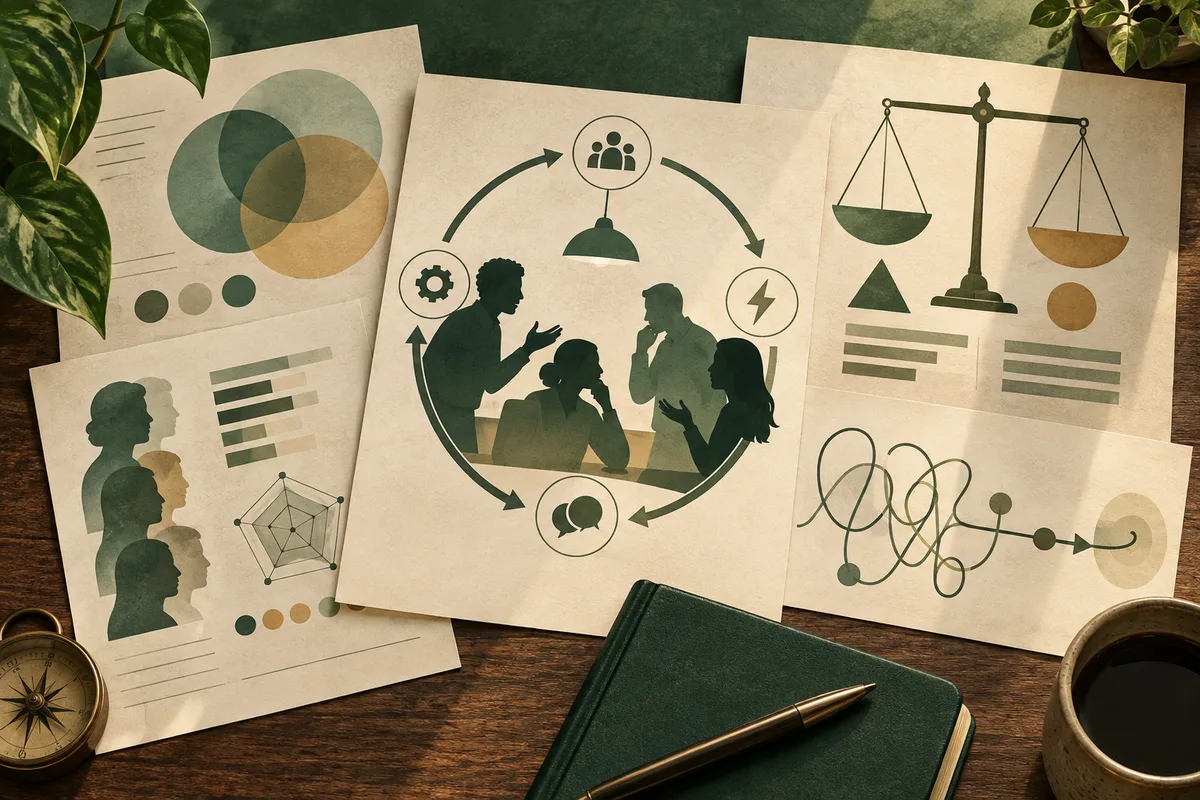
Use a personality report as an optional prompt for discussing one person’s tendencies, then compare that interpretation with a specific work exchange and the team’s process. A meta-analysis found associations between combined forms of deep-level team diversity and conflict, but such group-level findings do not explain why one team repeats a particular disagreement. Start with what happened, inspect handoffs and decision rules, and try one small change. The report may help people ask questions; it cannot diagnose a team or assign blame.
What can a report explain about repeated friction?
A personality report describes tendencies inferred from a person’s answers to a particular assessment. It may give someone language for a preference, such as wanting time to compare options before committing. That is a statement about a self-reported pattern, not a transcript of behavior in every meeting. It says nothing directly about a colleague’s intention or the team’s decision process.
Triana and colleagues’ 2021 meta-analysis covered 94 papers and 24,425 teams. It examined deep-level diversity: differences in less visible characteristics that included personality, values, and culture. These were combined forms of diversity, not a study of personality reports alone. The synthesis found associations between this diversity and team conflict, processes, and states. Its broad evidence base makes team interaction relevant, but the combined inputs and group-level outcomes do not show what caused a particular team’s repeated friction. The synthesis reports associations across studies; it does not establish that diversity itself caused conflict or that reading reports changes it. [Source 1]
That limit matters when comparing two explanations. A report-led account might say, ‘We clash because one person needs closure and another prefers exploring options.’ A process-led account asks when the clash occurs, who owns the decision, what counts as approval, and whether the deadline leaves time for review. The first can suggest a question. The second examines conditions participants can observe and potentially change. Treat report language as one hypothesis alongside process explanations, not as a verdict about either person.
Sources: The Relationship Between Team Deep-Level Diversity and Team Performance: A Meta-Analysis of the Main Effect, Moderators, and Mediating Mechanisms; Personality Tests
How can a team test a report-based hypothesis?
Begin with a recent incident described without trait labels. For example, consider an illustrative team that repeatedly disagrees about whether a draft is ready to send. Observable details might include late revisions, two people believing they have final approval, and no shared review cutoff. Calling one person ‘indecisive’ or another ‘rigid’ adds interpretation without clarifying what happened.
Separate disagreement about the draft’s content from uncertainty over who signs it off. The first concerns what the team should do; the second concerns how approval works. They can occur together, so ask what participants are actually disputing before interpreting a report. The research above concerns associations among teams; it does not test this incident, explain its cause, or show that reports prevent or resolve conflict.
Then use a practical three-step check. First, describe the exchange: what was said or changed, when, and by whom? Second, if participants choose to consult their reports, compare the exact wording with this situation. Ask whether the description fits here, where it does not, and what else could explain the action. A self-report may inform reflection, but it does not prove the motive behind one decision.
Third, inspect the work arrangement. Is the approver named? Does everyone know what ‘ready’ means? Are review time and revision authority clear? Could workload, competing incentives, or a deadline explain the pattern? Agree on one small process experiment, such as naming a single approver and setting a review cutoff. After a few comparable tasks, return to the same observable questions. If the friction changes, the process may have mattered; if it does not, reconsider the explanation. This is a proposed reasoning method, not a validated team intervention.
When should the report stay out of the decision?
Keep a general personality report out of decisions to diagnose, rank, select, or evaluate colleagues unless evidence supports that specific interpretation and use. The Standards for Educational and Psychological Testing frame validity in relation to evidence and theory supporting a proposed interpretation of scores for a proposed use. A score used for personal reflection does not automatically support a conclusion about a whole team or an employment outcome. [Source 2]
A voluntary development conversation differs from a manager using reports to label people or allocate work. Participants should be free to reject a description and offer examples that do not fit. Check other explanations too: authority, workload, unclear roles, incentives, or coordination demands. A report can still help when participants themselves recognize its language as useful for a difference they already observe. It may help them discuss a working agreement, while the team still checks whether that agreement helps.
The practical verdict is to begin with process and use reports only as optional prompts. The team-diversity synthesis offers context-bound associations, not a formula for resolving an incident; testing standards make score meaning depend on intended use. Write down one recent exchange, identify one unclear work rule, and agree when to review a small change. For private reflection on your own decision and collaboration tendencies, the Work Pattern Report at /assessment offers a low-stakes self-report across work-pattern continuums. It has no norms or employment recommendations and cannot tell the team what caused its friction.
Sources: Standards for Educational and Psychological Testing
Questions readers ask
Can a personality report explain why two coworkers keep disagreeing?
It can suggest a possible tendency to discuss, but it cannot establish why a specific disagreement happens. Compare the interpretation with observable exchanges, task demands, and team routines.
Should a team share everyone’s personality reports?
Only when participation is voluntary and the purpose is low-stakes reflection. A report should not be used to rank, diagnose, select, or evaluate colleagues without evidence for that use.
What should a team try before changing how people work together?
Describe one recurring incident in observable terms, check roles, deadlines, handoffs, and decision rights, then test one small process change and review what happens.
Sources and notes
- The Relationship Between Team Deep-Level Diversity and Team Performance: A Meta-Analysis of the Main Effect, Moderators, and Mediating Mechanisms
The publisher abstract states that the meta-analysis covered 94 papers, 280 effect sizes, and 24,425 teams; it examined deep-level diversity types including personality, values, and culture, and found associations with fewer positive emergent states and processes and more team conflict. The abstract does not establish causation, explain a particular team's friction, or test personality reports or the proposed process experiment.
- Standards for Educational and Psychological Testing
The Standards say validity concerns whether evidence and theory support interpretations of test scores for proposed uses. This supports limiting score interpretations to uses for which evidence and theory provide support; it does not evaluate the Work Pattern Report or a team intervention.
- Personality Tests
The U.S. Office of Personnel Management describes personality measures as including self-report inventories (questionnaires) and says these typically ask respondents to rate agreement with statements. This supports describing questionnaire-based reports as self-reports, but does not establish that a particular report accurately predicts behavior in a given meeting.
Apply it to your work
Turn a vague work question into specific observations
From this guide: A report may prompt reflection on how you decide, plan, handle disagreement, and collaborate, while the cause of a team’s friction still needs to be checked in its work process.
If you want to reflect on your own recurring work tendencies, the Work Pattern Report offers a private, low-stakes self-report across decision and collaboration continuums. Use its descriptions to form questions about real situations and compare them with your experience. It provides no norms or employment recommendations and cannot diagnose a team’s problem.