
A personality report's intended use is the interpretation and decision its developer has evidence to support, such as structured self-reflection, coaching discussion, or a defined assessment process. A use invented later starts with a different question, such as using a self-reflection profile to rank applicants or treating a descriptive tendency as a prediction of clinical risk. The score may be calculated correctly in both cases, but the meaning of the result changes. Validity is not a permanent property that makes every use of a test sound. It concerns whether evidence and theory support a particular interpretation for a proposed purpose. To read a report responsibly, identify what it measures, who its norms represent, what decision it was designed to inform, and what additional evidence would be needed for the decision you have in mind.
The same score can answer different questions
Imagine a report describing a person's responses on several broad personality dimensions. The report may be designed to help the person notice preferred ways of approaching planning, novelty, or social contact. That can support a reflective conversation: Which descriptions fit recent situations, and which do not? It does not automatically answer a different question: Who should be hired, promoted, diagnosed, or trusted with a particular responsibility?
The difference is not merely a disclaimer printed at the bottom of a page. It is a difference in the inference being made. An inference is the conclusion drawn from observed responses or scores. The first inference may be modest: this response pattern is consistent with a tendency worth exploring. The later inference may be much stronger: this person will perform well in a job, has a disorder, or should be excluded from an opportunity. Each new conclusion needs its own rationale and evidence.
A report can therefore be useful for one purpose and unsuitable for another without the score itself being defective. The practical question is not whether the report feels accurate. It is whether the proposed conclusion is supported for the decision at hand.
What intended use actually means
Intended use names the purpose, population, conditions, and interpretation a developer or test user has specified. A technical manual may explain what the instrument measures, how it is administered and scored, which people its reference data describe, and which interpretations have supporting evidence. The intended use is not always a single sentence. It is the boundary around the claims the report is prepared to make.
The Standards for Educational and Psychological Testing tell test users to examine a test's purpose, intended population, and available reliability and validity evidence before adopting it. They also say the test's name alone is not enough information for selection. This matters for online personality reports, where an attractive label or polished chart can conceal a narrow evidence base.
Reliability and validity answer different questions. Reliability concerns the consistency or precision of scores. Validity concerns whether evidence and theory support a particular interpretation for a proposed use. A report can have reasonably consistent scores while still lacking evidence for a new decision. Consistency does not turn a descriptive result into a hiring rule or a diagnosis.
How a later use gets invented
A later use often appears through a small change in wording. A report says someone tends to prefer quiet work, and a manager treats that as proof that the person cannot collaborate. A report gives a relative score on a trait, and a recruiter converts it into a rank order of applicants. A coaching report offers questions for reflection, and a reader treats its categories as fixed identity labels. The original report may never have made those claims.
This move can feel reasonable because the new claim is related to the measured construct. Related is not the same as supported. A measure of a broad tendency is not automatically a measure of every behavior associated with that tendency. Situation, training, incentives, health, language, opportunity, and other characteristics can affect what a person does. A personality score usually gives one source of information, not a complete account of conduct.
The risk increases when a later user adds a consequence. Reflection becomes selection. A conversation starter becomes a performance forecast. A pattern description becomes a label. The more consequential the decision, the stronger the need to inspect the evidence, the comparison group, the administration conditions, and the role of other information.
A concrete comparison: reflection versus hiring
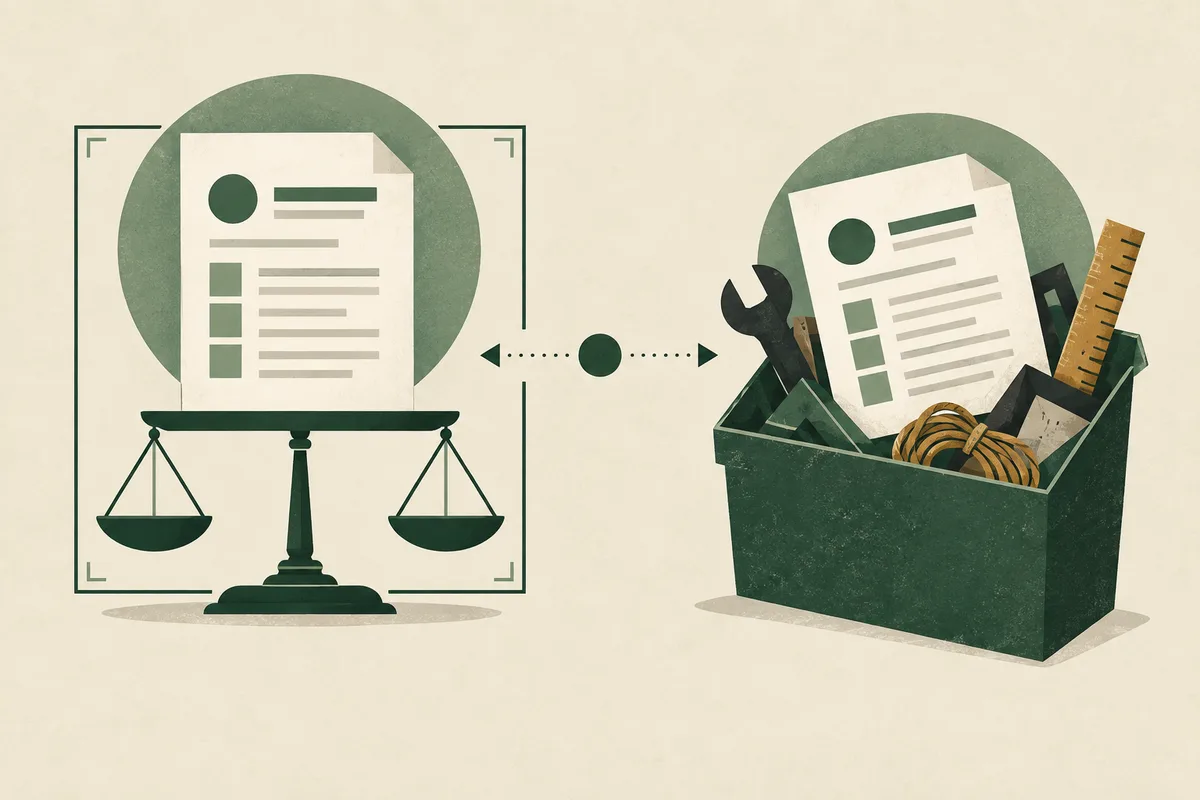
Consider two proposed uses of the same general personality report. In self-reflection, a reader uses a description of a tendency to choose an observation to test: During the next two project meetings, do I ask for clarification before offering a solution? The result supplies a prompt. The reader can compare it with actual behavior and revise the interpretation when the situation differs.
In hiring, an employer uses the same report to rank applicants for a role. That is a selection procedure, even if the report is presented as a culture or work-style exercise. The relevant question is now job-specific: Is there evidence that this score interpretation relates to important performance criteria for this job, for this population, under these administration conditions? A general association or a publisher's assertion is not a substitute for evidence matched to that use.
The U.S. Equal Employment Opportunity Commission's guidance illustrates the principle in the employment context. Validation means demonstrating job relatedness, and the guidance distinguishes evidence based on relationships with job performance, job content, or an underlying construct tied to successful performance. It also says a procedure's validity in one situation does not automatically establish validity in different circumstances. Employment law varies by jurisdiction, but the evidence lesson is broader: a report should not be stretched from reflection to selection by intuition alone.
What evidence would be needed for the new claim
When someone proposes a use outside the report's documented purpose, ask what interpretation is being added and what evidence would support it. For a workplace decision, that may involve a job analysis, a clear definition of performance, research linking the procedure to relevant criteria, attention to the intended applicant population, and monitoring for harmful consequences. For coaching, the evidence question may be smaller but still useful: Is the report being used to generate a tentative discussion rather than to assert that a person must behave in one way?
The Standards state that when little or no validity evidence exists for a purpose, the user is responsible for documenting the rationale and obtaining evidence for the reliability and validity of the scores for that purpose. They allow hypotheses to be generated from test data, but those hypotheses should be labeled tentative and their limitations made clear. That is a helpful middle position. It does not forbid curiosity. It prevents curiosity from being presented as established fact.
Also ask whether the norm group fits the person and the decision. A percentile is a comparison within a reference group, not a universal measure of merit. If the reference population, language, age range, setting, or administration differs materially, the interpretation may need qualification. A report that hides these details cannot support confident transfer to a new use.
Why a plausible story is not enough
Personality language is especially easy to overextend because it sounds familiar. Readers recognize examples, remember confirming moments, and overlook situations that do not fit. A report can offer a useful vocabulary for reflection while still being incomplete. The feeling that a paragraph describes someone well is evidence of recognition, not evidence that every prediction built from it is accurate.
A second problem is precision. A chart may show a score with several decimal places, but that display does not prove that the underlying distinction is equally precise. Measurement error, response conditions, missing context, and the limits of the norm group all affect what can reasonably be concluded. The Standards advise users to avoid interpretations that assign more precision than the evidence warrants and to consider possible positive and negative consequences.
A third problem is single-source decision making. The American Psychological Association's testing guidance advises users to avoid using a single test score as the sole determinant of decisions and to interpret scores with other appropriate information. That does not mean adding arbitrary impressions. It means deciding in advance what other relevant evidence is needed and how each source will contribute.
A report-reading test for responsible use
Before accepting a proposed interpretation, write the use as a complete sentence: We will use this result to make [decision] about [population] in [setting]. Then compare that sentence with the report's documented purpose. If the decision, population, or setting has changed, you have identified a transfer that needs justification.
Next, separate four layers. First, what was observed: responses, a raw score, a standardized score, a percentile, or a report band. Second, what was measured: a defined construct or tendency, as the instrument describes it. Third, what interpretation is supported: the conclusion for which evidence is available. Fourth, what action is proposed: reflection, a coaching question, selection, assignment, or another decision. Many overclaims happen when the action is smuggled in as though it were part of the score.
Finally, look for a stop rule. If the report does not identify its intended use, population, evidence, limits, and responsible user, pause before making a consequential decision. If the new use is high stakes, ask for qualified review and other appropriate evidence. If the purpose is modest self-reflection, keep the interpretation provisional and test it against observations rather than turning it into a verdict.
From a score to a proportionate next step
The safest next step depends on the purpose. For self-reflection, choose one observable behavior and one context in which to notice it. For coaching, use the report to frame questions, then include the person's own examples and goals. For development, define what change would look like and use measures that actually capture that change. For selection or other high-impact decisions, do not improvise a cutoff or rank from a report that was not validated for that use.
A responsible report does not need to be uselessly cautious. It can say what its scores describe, what comparisons they permit, how precise they are, and what they cannot establish. Clear limits make the useful part easier to see. They also protect the person being assessed from having a tentative tendency turned into a permanent identity or an unsupported decision.
The key distinction is simple: intended use is an evidence-backed interpretation chosen before the decision; an invented later use is a new interpretation that must earn its own support. Treat the second as a proposal to investigate, not as a fact inherited from the first.
Questions readers ask
Can I use a personality report for self-reflection if it was not designed as a diagnostic tool?
Possibly, if the report describes that as an appropriate use and you keep the interpretation tentative. Use it to generate questions about observable patterns, not to diagnose a condition or make a fixed claim about identity. Check the report's stated population, evidence, limits, and comparison group first.
Does a high reliability result prove that a personality report is valid for hiring?
No. Reliability concerns score consistency or precision. Validity concerns whether evidence supports a particular interpretation for a particular use. A consistent score can still lack evidence for hiring, promotion, diagnosis, or another decision.
Can an employer use a self-reflection personality report in recruitment?
Not responsibly without evidence supporting the employment interpretation and the way the report will be used for the specific job and population. A report intended for reflection should not quietly become a ranking or screening tool. Employment requirements also depend on applicable law and professional practice.
What should I do when a report does not state its intended use?
Pause before relying on it for a consequential decision. Ask what the instrument measures, who the norms represent, how scores are interpreted, what evidence supports those interpretations, and what uses are discouraged. If those answers are unavailable, limit the report to cautious reflection or choose a better-documented assessment.
Sources and notes
- Standards for Educational and Psychological Testing
Supports matching score interpretations to intended uses, populations, reliability, norms, consequences, and documented limits.
- APA Policy Archive: Testing and Assessment
Supports avoiding unsupported uses, considering norms and limitations, using multiple information sources, and warning against misuse.
- APA Guidelines for Psychological Assessment and Evaluation
Supports matching test construction, administration, scoring, interpretation, population, and context to the purpose of testing.
- Questions and Answers to Clarify and Provide a Common Interpretation of the Uniform Guidelines on Employee Selection Procedures
Supports the employment example that validation concerns job relatedness and does not automatically transfer across situations.
- APA PsycTests Methodology Field Values
Supports defining validity as evidence and theory supporting specific interpretations of scores for a proposed use.
Apply it to your work
Understand how you work before you choose what comes next.
From this guide: Carry this report-reading question into the work decision in front of you.
Build a private Work Pattern Report across ten workplace continuums, then compare the result with the demands of the role or environment in front of you.