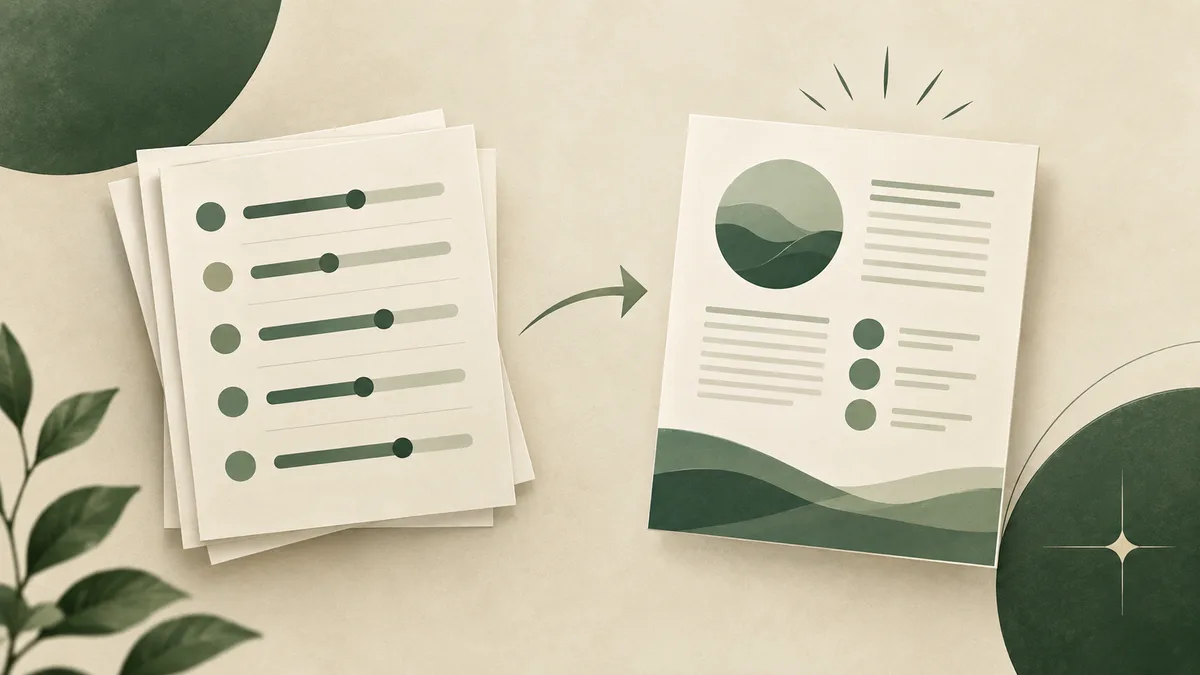
If you already have personality scores, use them as a starting point for a small, observable question—not as a verdict about who you are or what work you should do. Read the score in the context of its instrument and intended interpretation, translate one specific statement into a behavior you can notice, and look for both confirming and counterexamples across situations. A report may help explain unfamiliar results, but interpretation evidence does not establish that a score predicts a particular action or that feedback changes behavior. The useful outcome is a better question to check against experience.
When is a separate report worth paying for?
A personality score often becomes most tempting to use when a familiar situation keeps recurring: perhaps project handoffs feel draining, planning seems easier in some teams than others, or feedback lands differently depending on how it is delivered. The score may offer language for the pattern, but the first useful move is to describe the situation in ordinary terms. What happened, who was involved, and what did you do? That account gives you something observable to compare with the report’s broad wording.
Keep the question narrow. “What kind of person am I?” invites a totalizing answer that no single score can provide. “When do I ask for written next steps, and what happens afterward?” can be checked in actual episodes. A score may suggest where to look, but it cannot tell you in advance that one explanation caused every instance. Work behavior also reflects role demands, time, incentives, relationships, resources, and the particular task.
The evidence base does not establish that a separate paid interpretation improves outcomes over the score output alone. That gap does not make existing scores unusable; it means the practical aim should be modest. Treat a score as a prompt for inquiry, then see whether a specific description helps you notice a pattern that was otherwise hard to name. The experiment in this article is a short observation, not a test of the assessment’s scientific validity or a career recommendation.
Consider an unnamed hypothetical reader whose report describes a preference for planning. Instead of concluding “I cannot handle ambiguity,” they could ask whether written next steps help them begin a collaborative task sooner, and whether this changes when deadlines or role clarity differ. The score has helped choose a question; observations will determine whether the wording fits those situations. The reader could also compare a few episodes before drawing a conclusion, rather than treating a single difficult handoff as proof. A different pattern would be useful information too.
This distinction between a score’s interpretation and its use is supported by Samuel Messick’s ETS report on evidence and ethics in test evaluation. It treats what a score is taken to mean and the use made of it as related but distinct matters for validity. The report concerns tests broadly, not workplace experiments or consumer add-ons. Its relevance here is a boundary: a plausible reading of a score does not by itself justify every conclusion or action someone might attach to it.
What could a second report add to your scores?
Before translating any result into behavior, identify what the original assessment actually reported. Note the instrument and version if available, the scale or score label, and the explanation supplied by its publisher. Some scores compare a person with a reference group; other scores may be reported in a different way. A norm is a reference group used to interpret scores relative to a specified population. Do not assume that a percentile, “high” label, or comparison applies to you unless the documentation says what the scale means and who the comparison represents.
Reliability or precision concerns how consistently a score is estimated under relevant conditions and sources of error. Validity concerns the evidence supporting a particular interpretation and proposed use. These are not universal stamps that make every sentence in a report equally dependable. A score might support a limited description while leaving a proposed explanation, prediction, or recommendation unsupported. The more consequential the use, the more important it is to know what evidence applies to that use.
The *Standards for Educational and Psychological Testing*, from AERA, APA, and NCME, discuss evidence for interpretations and uses, norm relevance, context, and limitations of automated interpretations. They caution that computer-generated narratives can mislead when separated from other information. This is professional guidance, not a law and not an evaluation of every consumer report. For an individual reader, the practical lesson is to check whether the interpretation is tied to the named instrument and whether it explains the limits of what can be inferred.
The University of Minnesota’s FAQ about Minnesota Reports offers a deliberately bounded example. It describes reports based on MMPI-2 or MMPI-A score patterns and research literature, with narrative descriptions framed as hypotheses for qualified practitioners to follow up using interviews, observations, and other results. The FAQ concerns a specific clinical instrument and professional system; it does not show how other personality tests should be interpreted. It does illustrate why context and follow-up can matter even when an interpretation is grounded in a defined score pattern.
If your own score page omits information needed to understand the result, look first for the assessment’s official documentation or ask its provider what the scale means. A second narrative cannot reconstruct missing scoring details merely by sounding fluent. Where the intended use is clinical, employment-related, or otherwise consequential, the appropriate next step may be someone qualified to interpret that specific assessment. For a low-stakes reflection, it may be enough to leave the uncertain claim aside and observe the situation directly.
Sources: Standards for Educational and Psychological Testing; Frequently Asked Questions about the Minnesota Reports
What should a report show before you pay?
Broad trait language is difficult to test because it can seem to fit many situations. Convert one sentence into a behavior, a context, and an observation window. If the sentence is “I prefer clear plans,” a possible question is: “During the next two weeks, when a shared task has written next steps, do I start sooner or coordinate more easily than when responsibilities are unclear?” The wording should describe something visible, not an inner essence that cannot be checked.
Decide what would count as an instance before you begin. For example, record whether next steps were written down, how long it took to begin, and whether a handoff needed clarification. Keep notes brief and factual. Do not manufacture a numerical score or treat a handful of observations as a validated measure. The aim is to remember situations accurately enough to compare them, not to build a replacement personality test.
Also decide what would count against the first interpretation. Perhaps clear plans do not help when the task is unfamiliar, or a flexible verbal check-in works just as well. Maybe the apparent effect is explained by workload or whether the other person responds promptly. A useful hypothesis can survive some exceptions while becoming more specific: written steps may help when ownership is shared and timing is tight. That statement is narrower and more useful than “I need structure.”
A report can contribute by suggesting a question or organizing a set of results, but it should distinguish score-based interpretation from a practical prompt. If the report makes a claim about what you always do, ask what evidence would let you test that claim and what might disconfirm it. If it offers advice, consider whether the advice follows from the score or is simply a general suggestion. You can try a low-risk suggestion without treating it as proof that the report diagnosed you correctly.
This is an experiment in everyday observation, not a controlled study. You cannot isolate every factor at work, and your memory or recording may be selective. Keeping the observation close to the event and noting context can make reflection more disciplined, but it does not produce causal proof. If the same question matters for an important decision, gather broader evidence and consult a suitable professional rather than relying on a short personal log.
Sources: Standards for Educational and Psychological Testing
How much uncertainty remains after interpretation?
People often notice examples that fit an interpretation more readily than examples that do not. Davies reported three studies involving 223 college students aged 18 to 38. Participants generated more confirming than disconfirming evidence for personality feedback; the availability of confirming examples tracked perceived accuracy, and general feedback received higher accuracy ratings than more specific feedback. These studies concern judgments about feedback in a student sample. They do not show that every general statement is false, or that specific statements are true. They do support a simple safeguard: deliberately ask what you would expect to see if the interpretation did not fit.
A separate 2019 meta-analysis compared self- and informant-report means for Big Five traits across 152 samples and 33,033 targets. The average self/informant difference was small, and the researchers did not find a general pattern of people rating themselves more positively. Differences were more moderate when self-ratings were compared with ratings from strangers. Those results are group averages, not a verdict on any one person’s score, and they do not validate a particular report or work-pattern claim.
Taken together, these findings argue for balanced checking rather than blanket distrust of self-report. Ask a trusted colleague for a concrete example only if that is appropriate and safe; another person sees only part of your behavior and may have their own perspective. Compare accounts of a specific event rather than asking someone to certify your personality. “What happened during that handoff?” is more answerable than “Am I bad at collaboration?”
If your observations repeatedly contradict the report’s description, possible explanations include a mismatch between the report and instrument, a context-specific tendency, measurement uncertainty, or a broad phrase that does not discriminate well. You do not have to force a fit. Keep what helps you ask a clearer question and set aside claims that do not match the situations you can examine. Disagreement is information, not automatic proof that the assessment or the reader is wrong.
A true-sounding interpretation can also be accepted without changing self-attitudes. In an older experimental study, Bradley and Bradley reported that participants rated genuine test-based personality interpretations as fairly accurate, while feedback did not produce measured changes in self-attitude. The accessible abstract gives limited methodological detail and does not test modern paid reports or lasting behavior. It is a reminder that perceived accuracy, personal usefulness, and behavior change are separate outcomes.
Sources: Self-Other Agreement in Personality Reports: A Meta-Analytic Comparison of Self- and Informant-Report Means; Positive test strategies and confirmatory retrieval processes in the evaluation of personality feedback; Experimenter prestige and feedback related to acceptance of genuine personality interpretations and self-attitude
When can feedback change what you do?
Feedback research varies in what it tests: the population, report, comparison group, and outcome all matter. In a randomized trial, 372 adults with current or past cancer diagnoses received either a brief Big Five feedback report with tailored self-care tips or generic personality theory. The trial found no effect on its primary self-awareness outcome or positive affect, while immediate illness-management self-efficacy outcomes showed modest differences, including for symptom and treatment management. The report and tips were designed for a health context; these outcomes and this population differ from ordinary work reflection.
The trial cannot establish that a generic consumer report improves workplace behavior, nor that no reader will find a report useful. It shows why claims that “personality feedback works” need a named outcome and context. Greater confidence about managing treatment is not the same as more accurate self-understanding, a lasting habit change, or a better career decision. Those outcomes would need to be measured directly in a relevant population, against an appropriate alternative, and over a suitable period.
The Bradley study concerns acceptance of feedback and measured self-attitudes, not whether a report helps someone run a practical experiment. The Minnesota documentation explains a professional MMPI use as hypotheses for follow-up, but it is instrument-specific. The cancer trial adds a distinct health-intervention example, not a direct comparison of paid add-ons with the same scores and official documentation alone. Together, these sources set boundaries; none answers whether a particular reader should buy a particular report.
For your own low-stakes question, define usefulness before you start. It might mean noticing a condition under which you begin tasks more easily, finding a concrete discussion topic, or deciding that a report’s wording does not fit. It need not mean proving the assessment accurate or transforming behavior. A modest, reversible action can be worthwhile to you even when broader outcome benefits have not been established; that is a personal judgment about usefulness, not a scientific finding about all reports.
If someone is asking you to use a personality result to make a consequential decision, do not let a consumer narrative stand in for the other relevant evidence. A general personality report is not, by itself, a diagnosis, hiring score, promotion criterion, or recommendation about which job to take. Seek guidance from a qualified person familiar with the instrument and purpose, and consider the broader circumstances that bear on the decision.
Sources: Frequently Asked Questions about the Minnesota Reports; Experimenter prestige and feedback related to acceptance of genuine personality interpretations and self-attitude; Personality Feedback With Tailored Self-Care Recommendations Improves Self-Efficacy for Cancer Management: A Randomized Controlled Trial

Which option fits your question: scores alone, a report, or a conversation?
Choose the next step according to the question, not the apparent depth of the report. If you can understand the score from the original provider’s documentation and have a narrow observation in mind, you may be able to proceed without buying another interpretation. If terminology or score structure is unclear, consult the official explanation first. That source is most likely to describe how the instrument was scored, although its explanation may not answer every personal question.
A separate narrative can be convenient when it makes an otherwise opaque result easier to discuss. Its added value for your experiment is organizational: does it point to a behavior and context you can observe, and does it keep that suggestion distinct from what the score itself establishes? More pages do not necessarily mean more evidence. If you are considering a paid product, the relevant question is whether its promised interpretation addresses a real gap for you; the usual transparency checks are useful here, but they are not the article’s verdict or a universal purchasing checklist. The same distinction applies to a polished explanation: clarity can lower the effort required to use information, but it does not supply missing norm data, establish the original score’s precision, or demonstrate that the added account fits you. Look for a traceable path from the known score and its stated limits to the proposed interpretation, then decide whether that interpretation helps with your specific question.
A conversation may be a better fit when the instrument is specialized, when results conflict with important information, or when someone intends to use the result in a high-stakes setting. The relevant expertise depends on the test and purpose. A coach might help structure a low-stakes workplace observation; a professional trained in a specific clinical instrument may be needed for its interpretation. Do not assume either role is necessary for every personality score, and do not treat a commercial narrative as equivalent to a qualified assessment.
The Minnesota Reports example makes this distinction concrete only for the MMPI family: the University of Minnesota describes professional use and contextual follow-up for those reports. It cannot be generalized to every instrument, but it illustrates that the right interpretation can depend on audience and purpose. For ordinary self-reflection, you can often begin with a cautious question. For consequential use, the question is not simply which report is longer, but what evidence and expertise the decision requires.
A sensible progression is to understand the original score, select one low-risk behavior to observe, and seek help if the score’s meaning or intended use exceeds what you can responsibly interpret. This keeps the score in proportion. It also leaves room to decide that no further interpretation is needed: a vague label that does not produce a useful, testable question need not control your next move.
Sources: Standards for Educational and Psychological Testing; Frequently Asked Questions about the Minnesota Reports
What is the practical verdict for the report you already have?
At the end of the observation period, review the examples rather than asking whether the original label feels true. Did the behavior occur in the expected context? Were there counterexamples? Did another condition—workload, task familiarity, unclear ownership—explain the difference better? The purpose is not to produce a final score about yourself. It is to improve the next question you ask or the next small adjustment you try. If you are comparing options, apply the same question to each: what new information would this route provide, and what would count as a useful answer? Official documentation may clarify scoring; a separate report may organize results; a qualified discussion may add context. Their roles differ, so compare the one you need rather than the amount of material each provides.
Suppose written handoff notes seemed helpful in two situations but made little difference in three others. You might refine the idea: the notes helped when more than one person owned the task, while familiarity or time pressure mattered more elsewhere. Or you may conclude that the report’s planning description was too broad to guide this decision. Both outcomes are legitimate. Neither confirms or refutes the assessment as a whole.
Keep the conclusion attached to the conditions you observed. “I coordinated more smoothly when ownership and next steps were explicit on these projects” is more defensible than “I am a planner” or “I cannot work with ambiguity.” The first describes evidence from a limited set of situations. The latter turns a possible tendency into a stable identity claim. A score may summarize responses under one assessment’s conditions; it does not capture every role, relationship, or day.
If the observation suggests a change, make it small and reversible. You might agree on a short written handoff for a particular project, then check whether it reduced clarification later. This is a workplace experiment in the ordinary sense, not a research design and not a performance metric. Avoid using it to monitor someone else or to justify a judgment about their ability. The aim is to learn what helps a task proceed, not to sort people into types.
If no useful pattern emerges, let the question go or gather more relevant context. You are not obliged to keep interpreting a score because you have it. The result may be too broad for the problem, the situations may vary too much, or a different source of information may matter more. A careful reader can use a score provisionally while declining to make it the explanation for everything.
Sources: Standards for Educational and Psychological Testing
What if your scores leave a work-pattern question?
Work questions can be especially easy to overstate because a trait description may sound like a career prescription. A preference or self-reported tendency does not establish which occupation will suit you, predict performance, or determine whether you should accept a role. Skills, values, health, resources, team practices, opportunities, and constraints all matter. Use a personality result, at most, to identify a work situation worth examining alongside those other factors.
If you want structured prompts for that reflection, the Work Pattern Report at `/assessment` offers a self-report across ten decision-and-collaboration continuums. It is a low-stakes reflection tool, not a validated employment assessment; it supplies no norm, cutoff, type, or selection score and is not for hiring, promotion, compensation, performance management, diagnosis, or surveillance. It does not interpret or validate scores from another assessment. Its role is simply to help name observations you may want to test in real situations.
For broader guidance on reading assessment results, `/topics` collects personality-report literacy material. Whether you use that resource, the original score documentation, or no additional tool, keep the same boundary: describe a specific situation, test a tentative interpretation against examples on both sides, and avoid converting the result into a fixed account of yourself. The score can start an inquiry; your context and evidence determine what you can reasonably conclude.
Sources: Standards for Educational and Psychological Testing
Questions readers ask
Can I use a personality score to test a work pattern?
Yes, as a tentative prompt for a narrow observation, not as proof of a trait or career fit. Choose one behavior and context, record examples and counterexamples, and consider other explanations such as workload or role clarity.
Does a report make my existing personality score more accurate?
A narrative can explain or organize a score, but does not make the original measurement more accurate by itself. Check the instrument’s own documentation and whether the interpretation stays within evidence for that score and its intended use.
What if my experience conflicts with the report?
Do not force a match. The result may be broad, context-dependent, or uncertain, and your observations may cover only some situations. Compare specific examples and counterexamples; seek qualified interpretation if the intended use is consequential.
Sources and notes
- Evidence and Ethics in the Evaluation of Tests
The ETS abstract distinguishes the evidential and consequential bases for test interpretation and test use, and says intended purpose and applied setting matter. It does not evaluate paid consumer reports.
- Standards for Educational and Psychological Testing
The 2014 AERA, APA, and NCME standards call for evidence and rules supporting computer-generated interpretations, appropriate and documented norms, and caution against relying solely on computer-generated interpretations. They are professional standards, not an evaluation of consumer reports.
- Frequently Asked Questions about the Minnesota Reports
The University of Minnesota FAQ describes MMPI-2 and MMPI-A norm samples and says the Minnesota narrative interpretations can serve as hypotheses for practitioners to review alongside scores and client context. This example is specific to those instruments and professional evaluations.
- Self-Other Agreement in Personality Reports: A Meta-Analytic Comparison of Self- and Informant-Report Means
The PubMed abstract reports a meta-analysis of 152 samples and 33,033 targets: average Big Five self-report means generally did not differ from informant-report means, with moderate differences only for self versus stranger reports. These group means do not validate an individual score or report.
- Positive test strategies and confirmatory retrieval processes in the evaluation of personality feedback
The PubMed abstract reports three studies with 223 college students: participants generated more confirming than disconfirming evidence; confirmatory evidence availability related to rated accuracy, and ratings and confirming evidence were greater for general than specific feedback. This concerns student judgments of feedback, not the truth of every interpretation.
- Experimenter prestige and feedback related to acceptance of genuine personality interpretations and self-attitude
The PubMed abstract reports that participants rated genuine test-based interpretations fairly accurate, acceptance did not vary with experimenter prestige, and feedback did not affect measured self-attitudes. It does not establish effects of modern paid reports or lasting behavior.
- Personality Feedback With Tailored Self-Care Recommendations Improves Self-Efficacy for Cancer Management: A Randomized Controlled Trial
The publisher abstract reports a randomized trial of 372 adults with current or past cancer diagnoses comparing brief Big Five feedback plus tailored self-care tips with generic personality theory. It found no effect on primary self-awareness or positive affect, and modest immediate differences in illness-management self-efficacy. The health context and outcomes do not establish benefit from generic paid reports, workplace behavior change, or lasting effects.
Apply it to your work
Turn a work-style question into something you can observe
From this guide: If your scores leave you wondering how planning, feedback, or ambiguity shows up in your work, start with a specific situation rather than another broad label.
The Work Pattern Report offers prompts across ten decision-and-collaboration continuums so you can reflect on how you approach work situations. It is a low-stakes self-report without norms or employment decision validity. Use it to name observations for reflection, not to rank careers or make a hiring decision.