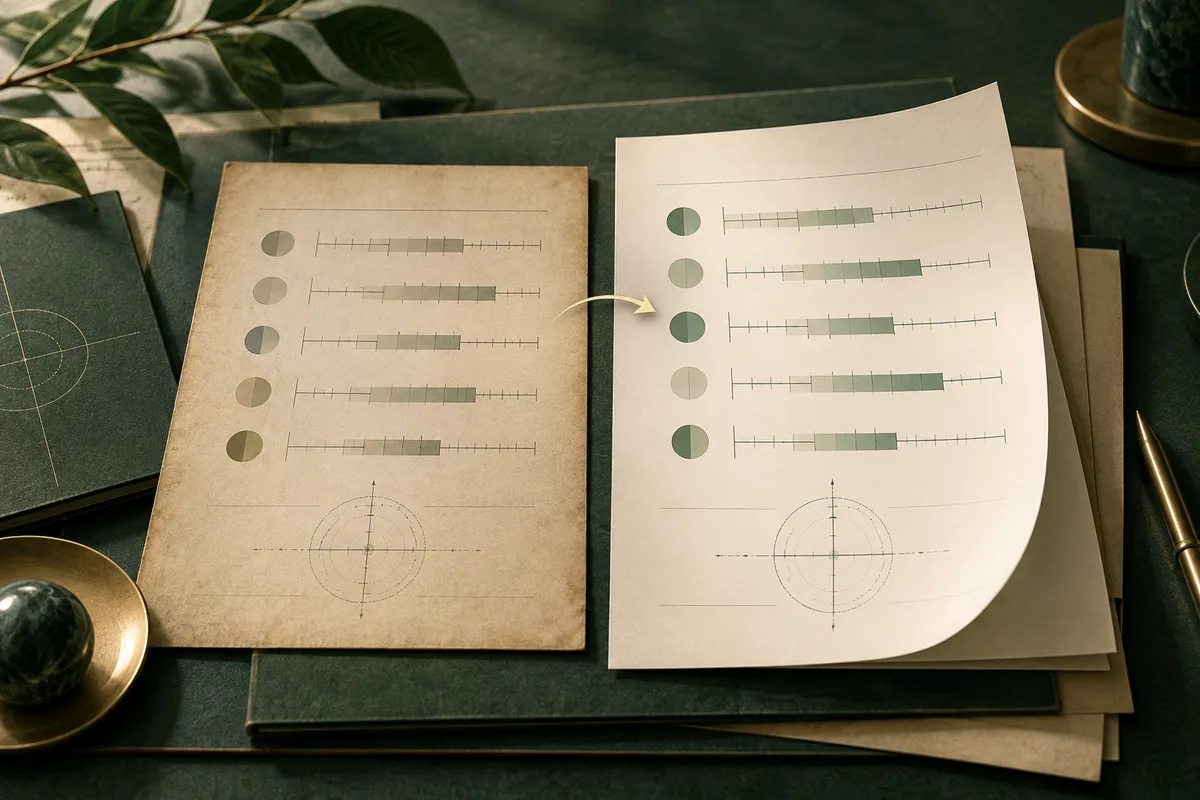
The 2024 NEO-PI-3 Normative Update changes the comparison norms, not the legacy items or scoring, according to publisher PAR. An older report remains a record of answers interpreted against its original reference group; its percentile should not be silently treated as a rank against the updated norms. If the original response data are available, PAR says they can be entered to produce a Normative Update report. Comparing those reports holds the answers constant and helps isolate the norm change. To assess change over time, compare administrations on a common norm basis and compatible forms instead.
What changed in the 2024 NEO-PI-3 update?
The central change is the yardstick, not the questionnaire. PAR says the NEO-PI-3 Normative Update keeps the legacy items and scoring, while using norms collected in 2024 and adding optional Positive Presentation Management and Negative Presentation Management scales. Norms are score distributions from a specified reference group; they help interpret where a result sits relative to that group. PAR describes the new sample as representative of the current U.S. population. It reports 1,855 self-report participants and 1,200 informant-report participants, aged 12 and above. Those details describe the publisher’s sample; they do not make every national, language, age, or decision context interchangeable.
This distinction matters because a norm-referenced score depends on the comparison distribution. The same answers can map to a different standardized score or percentile when the norms change. That possibility does not mean every individual’s score will move, or that it will move in a particular direction. The public product information does not give a universal person-level conversion or an expected shift.
Sources: NEO Personality Inventory-3 (Normative Update), PAR product page and FAQ; NCME Assessment Glossary
How can I separate a norm change from a change in answers?
Hold the answers constant first. PAR says that if a legacy report has already been run, the data set from that administration can be manually entered as a Normative Update administration to generate a new report. Comparing the old report with this matched rescore makes the reference frame the main changed element, assuming the response data and applicable form are compatible. It does not show that the respondent changed; the answers are the same.
A comparison across two dates asks a different question. If the earlier administration uses legacy norms and the later one uses updated norms, a score difference can reflect both changed answers and a changed reference distribution. Those effects are confounded, meaning the comparison cannot tell which produced the difference. A cleaner time comparison uses the same norm basis for both administrations, with compatible forms and respondent conditions. It still needs cautious interpretation: a numerical difference alone does not establish a meaningful change in a person’s tendencies.
A practical rule follows: same responses plus different norms helps inspect a reference-frame effect; different responses plus one common norm basis is more informative about score change. If the old record lacks its response data, ask the qualified test user or PAR what can be recovered. Do not estimate a conversion from memory or assume a percentile shift from the update announcement.
Sources: NEO Personality Inventory-3 (Normative Update), PAR product page and FAQ; NCME Assessment Glossary
What does an older percentile still tell me?
It tells you where the score ranked in the specified distribution used for that report. NCME defines a percentile rank as the percentage of scores in a specified distribution below a given score. It is a relative rank, not a percentage of a trait a person possesses. An older percentile therefore remains interpretable as a dated comparison, provided the report’s norm group and version can be identified. It is not automatically the percentile the same answers would receive under the 2024 norms.
Start with the report date, form, respondent type, norm group, and score format. The publisher’s sample report illustrates the sort of provenance fields a reader may see: it labels a form, test date, and normative group. Its displayed example results belong to a sample client and should not be used as a conversion guide or as evidence about another person. Look for the norm label on the actual report, and ask the report provider if the label is unclear.
Keep the historical report if it helps explain what was recorded at the time. If you need a present-day norm comparison, request a new report from the same response data where possible. Do not relabel the old percentile or place values from different norm systems side by side as though they were on one unchanged scale.
Sources: NEO Personality Inventory-3 (Normative Update), PAR product page and FAQ; NCME Assessment Glossary; NEO-PI-3:4FV Self-Report Form Sample Score Report, PAR
What can the update settle, and what should I do next?
The update offers a recent U.S. reference sample for interpreting compatible NEO-PI-3 responses against that reference. PAR describes the sample and provides a route for entering legacy response data. Those product details do not establish that the U.S. norms fit every reader’s country, language, age, or intended question; check the specific report and ask its qualified user what comparison it supports.
The optional presentation-management scales are also context, not a verdict. Their availability does not show that an individual answered inaccurately, and the update does not turn the inventory into a diagnosis or a hiring score. Geography, language version, age, self-report versus informant form, and the question being asked all affect how far a comparison can be carried.
Verdict: use an older NEO-PI-3 report as a record tied to its original norms, not as if it already reflected the 2024 reference group. First find its date, form, and norm label. Next, request a matched rescore if a current comparison matters. Then decide whether you need historical interpretation or a careful comparison over time. If the result will shape an important work decision, ask a qualified test user to interpret the specific reports and explain what the comparison can establish.
Sources: NEO Personality Inventory-3 (Normative Update), PAR product page and FAQ; NCME Assessment Glossary
Sources and notes
- NEO Personality Inventory-3 (Normative Update), PAR product page and FAQ
PAR says the update retains the legacy items and scoring, uses norms collected in 2024, adds optional PPM and NPM scales, and includes sample sizes of 1,855 self-report and 1,200 informant participants aged 12 and above. PAR also says legacy response data can be manually entered for a Normative Update report. It does not provide a universal person-level conversion or predict individual score shifts.
- NCME Assessment Glossary
NCME defines norm-referenced interpretation as comparison with performance in a specified reference population, norms as statistics summarizing score distributions for specified groups, and percentile rank as the percentage of scores in a specified distribution below a given score.
- NEO-PI-3:4FV Self-Report Form Sample Score Report, PAR
PAR's sample report labels the test form, test date, and normative group. It is explicitly a sample-client report and supports only the example of report provenance fields, not results or conversions for real readers.
Apply it to your work
Turn a broad work-style result into questions you can observe
From this guide: A norm update can clarify how a past score was compared, while leaving open how your decision and collaboration tendencies show up in current work.
If the report has clarified its norm group but your work question is still broad, the live Work Pattern Report offers a low-stakes self-report across decisions, planning, ambiguity, feedback, conflict, collaboration, ownership, change, and learning. Use its prompts to name a pattern and compare it with real examples from your work. It is not normed or validated for hiring, promotion, or job matching, and it does not choose a career for you.