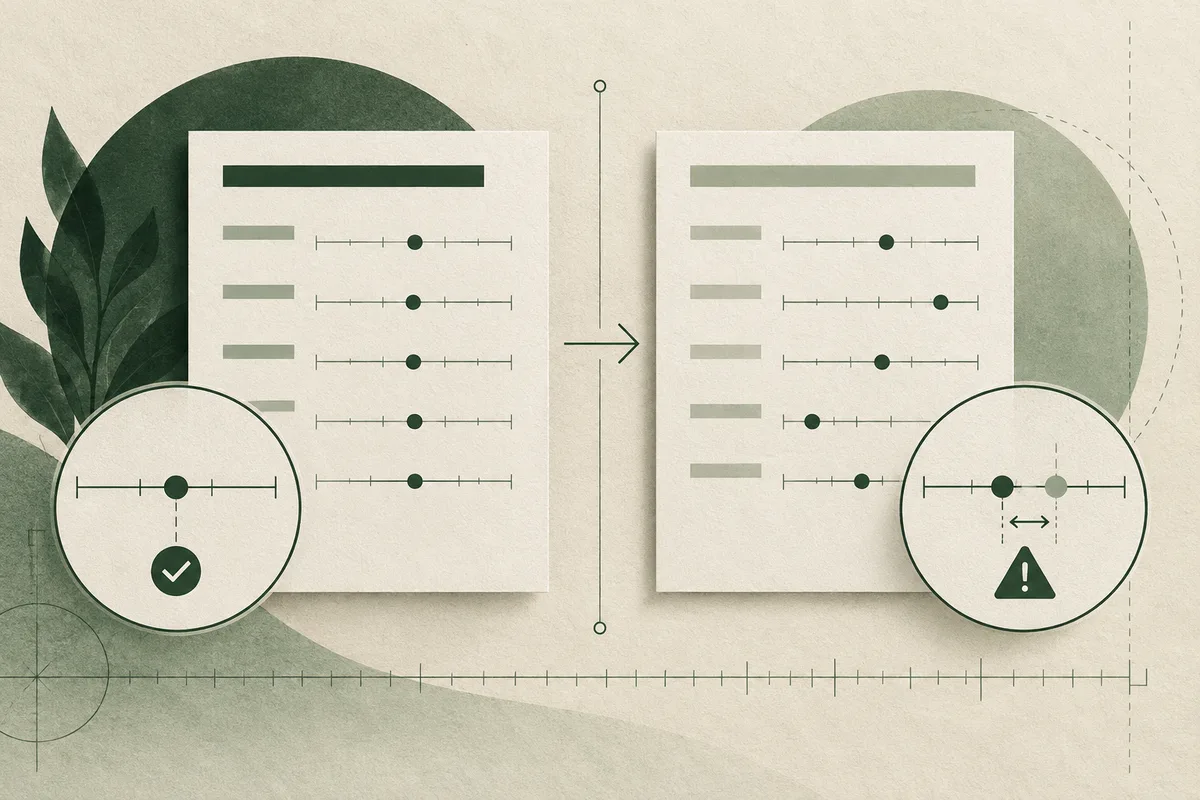
If two NEO-PI-3 reports differ, first check whether one uses the 2024 Normative Update. PAR says the update keeps the legacy items and scoring but uses refreshed US norms and adds optional response-presentation scales. Because a norm is the reference group used to interpret a score, the same answers may receive a different relative comparison under a different norm set. That difference alone does not show that the person changed. The public documentation describes the update but does not publish a direct old-versus-new score-linking analysis for individuals.
What changed in the 2024 NEO-PI-3 update?
PAR describes the Normative Update as a change to the reference data, not a new questionnaire: the 240 items and scoring are unchanged from the legacy NEO-PI-3. The publisher says it collected new norms in 2024 from 1,855 self-report and 1,200 informant-report respondents aged 12 and above, and describes the sample as representative of the current US population. Norms are data from a reference population used to interpret scores. PAR also added optional Schinka, Kinder, and Kremer (SKK) Positive and Negative Presentation Management scales. These indicate response presentation; they are not proof that a respondent lied.
The update also consolidates print forms and refreshes digital reports and the professional manual. PAR reports internal-consistency and retest-reliability summaries for the updated forms. Reliability concerns score consistency under specified conditions; it does not establish validity for every purpose or explain the size of any difference between old and updated reports. These sample counts, representativeness description, and reliability estimates are publisher-reported. The public product page does not provide enough detail to independently assess recruitment, weighting, or precision for every subgroup.
A T score expresses a result relative to a norm reference. PAR's sample Normative Update report identifies the form, test date, and “Combined Age/Combined Sex” norm group. That example confirms what a reader can check on that report; it does not show that readers can choose among groups in the updated product, or establish which group an older report used. The documented change is that the update uses US norms collected in 2024. A stable item set may therefore be interpreted using refreshed reference data, but the exact old-to-new comparison needs report-specific evidence.
Sources: NEO Personality Inventory-3 (Normative Update), PAR product and technical information; NEO-PI-3 Self-Report Form Score Report: Normative Update, sample report
Why can two reports disagree if the answers did not change?
A norm-referenced score combines answers with a reference frame. If the same response data are interpreted against different norm data, their relative position can differ. That possibility is the basic logic of norm-referenced interpretation, not evidence that a person's answers or personality changed. PAR says legacy response data can be entered into the updated system to generate an updated report. This allows rescoring of legacy responses, according to the publisher, but its public materials do not provide a paired old-versus-new score analysis quantifying how often or by how much individual results differ.
Historical NEO-PI-3 work also distinguished age norm frames, but its scope should be stated precisely. The accessible abstract of McCrae, Martin, and Costa's 2005 paper reports an adolescent sample of 500 and an adult sample of 635, and discusses age-specific and combined-age norms. It notes that combined-age norms may suit describing individual scores, while within-age norms may serve other purposes. These are findings reported in the abstract about earlier work; they do not test the 2024 update, establish a difference between a particular older report and the update, or show that users can select norm groups in the updated product.
Consider the same completed response set rescored under a legacy and an updated reference, if the provider can perform that comparison. A difference would describe relative standing under those references, not a second observation of the respondent. A retest is different: answers may also have changed. Since the published PAR materials do not give paired score results, a reader should not assume a particular shift or its size. Check the report version and ask the provider what is known about the two scores before attributing a discrepancy to personal change.
Sources: NEO Personality Inventory-3 (Normative Update), PAR product and technical information; Age trends and age norms for the NEO Personality Inventory-3 in adolescents and adults
Which older report comparisons should I avoid?
Avoid treating an old and updated percentile, T score, or band as directly interchangeable without checking the reports' norm basis. A percentile describes position within a reference group, so interpretation depends on which reference was used. Also avoid treating unlike forms as though the norms were the only difference: a full NEO-PI-3 and the 60-item NEO-FFI-3, a four-factor form, self-report and informant report, or different language and national editions differ in other ways too. PAR lists these as distinct products and describes the Normative Update as US-based.
Record the form, administration date, respondent type, and report version from each document. The sample update report identifies a self-report form, its date, and Combined Age/Combined Sex norms. That is a confirmed example for this sample report only. It cannot tell us what comparison basis an older report used, whether its basis was different, or whether the updated system offers alternatives. If information is missing, describe the result as a difference between reports rather than a measured shift in the person's traits.
General testing standards offer a sound reason to keep norm claims bounded. The joint AERA, APA, and NCME Standards discuss the construction and interpretation of group norms, including problems that can arise when groups differ in size or heterogeneity. These are broad professional standards, not findings about this product or a claim that its US sample fails to represent anyone. PAR's description of its sample as representative of the current US population remains a publisher claim; the public product summary does not provide the full sampling detail needed to independently evaluate that claim.
Sources: NEO Personality Inventory-3 (Normative Update), PAR product and technical information; NEO-PI-3 Self-Report Form Score Report: Normative Update, sample report; Standards for Educational and Psychological Testing
How should I interpret an apparent change?
The defensible conclusion is conditional: PAR says the update refreshes US norms collected in 2024 while retaining legacy items and scoring, so a difference between reports may reflect a changed norm reference. It should not be called personal change based on displayed scores alone. The exact conclusion depends on the reports' form, respondent type, response data, and norm basis. Public product materials do not offer a direct old-versus-new concordance study that lets a reader estimate the likely shift for an individual.
There is a reasonable case for refreshing norms: recent data may describe a current population more closely than older data. PAR describes its 2024 sample as representative of the current US population and reports reliability summaries. Those are relevant product facts, but they are publisher-reported. Newness alone does not establish improved interpretation for every subgroup or purpose; reliability is not validity, and an update does not prove that a particular person's score is more accurate. More public sampling detail and paired scoring results would make those questions easier to assess.
For a practical next step, ask the report provider: “Were both reports scored from the same NEO-PI-3 form and response data, and what norm basis does each report identify? Can you rescore the same responses under the update?” If the provider cannot answer, treat the discrepancy as unresolved rather than choosing the more flattering or recent label. In coaching or self-reflection, connect a score to concrete examples and context. The report describes tendencies relative to a reference; it does not settle why a particular behavior occurred. If a consequential interpretation depends on a score difference, ask for the underlying report pages or a written explanation of the scoring conditions. Keep any interpretation within the assessment’s stated purpose and treat response-style indicators as prompts for context, not conclusions about honesty. A cautious comparison can clarify what changed in the measurement reference while leaving unanswered what the score means in a person’s everyday life.
Sources: NEO Personality Inventory-3 (Normative Update), PAR product and technical information; NEO-PI-3 Self-Report Form Score Report: Normative Update, sample report; Standards for Educational and Psychological Testing
Questions readers ask
Did the NEO-PI-3 questions change in the 2024 Normative Update?
PAR says the legacy items and scoring did not change. The update uses new US norms collected in 2024 and adds optional SKK Positive and Negative Presentation Management scales.
Can I compare my old and updated NEO-PI-3 scores directly?
Only after checking form, response set, norm group, and report version. If the norm reference differs, treat a score difference as a change in relative comparison unless a qualified provider can establish more. Public product documentation does not publish an individual old-to-new score crosswalk.
Sources and notes
- NEO Personality Inventory-3 (Normative Update), PAR product and technical information
PAR states that the Normative Update retains legacy items and scoring, uses norms collected in 2024, and includes optional SKK scales. The page reports 1,855 self-report respondents aged 12 and above and 1,200 informant respondents, internal-consistency and retest-reliability summaries, and that legacy response data can be manually entered to generate an updated report. PAR also says score conversions use a choice of normative comparison groups. These are publisher statements; the page does not supply paired old-versus-update score results or full sampling details.
- NEO-PI-3 Self-Report Form Score Report: Normative Update, sample report
The opened sample report identifies a Self-Report Form, test date 12/10/2024, and the norm group “Combined Age/Combined Sex”; it displays T scores and ranges. It is an illustration of this report's metadata and does not establish the norm basis of older reports or which groups users can select in the updated product.
- Age trends and age norms for the NEO Personality Inventory-3 in adolescents and adults
The accessible abstract reports age trends from combined adolescent (n=500) and adult (n=635) samples, discusses self-report and observer-rating norms for adolescent, younger and older adult, all-adult, and combined-age groups, and says combined-age norms may suit depicting individuals' personality scores while within-age scores may serve some purposes. This is historical work and does not evaluate the 2024 update.
- Standards for Educational and Psychological Testing
The joint AERA, APA, and NCME standards state that norms should refer to clearly described populations and that reports of norming studies should describe the sampled population, sampling procedures, participation rates, weighting, testing dates, descriptive statistics, and precision. They also caution that group norms can be problematic when group sizes differ materially or groups vary in heterogeneity. These are general testing standards, not an evaluation of the NEO-PI-3 update.
Apply it to your work
Turn a broad work-style result into a specific question
From this guide: A norm comparison can describe relative standing, but it does not show how a tendency appears in a particular work decision or collaboration.
If comparing reports leaves you with a broad work-style label, the live Work Pattern Report offers a low-stakes way to reflect on ten decision and collaboration continuums, including evidence, ambiguity, feedback, conflict, and learning. It has no norms or hiring score; use it to frame observations and questions about your own work pattern, not to select a career or evaluate someone for a role.