
Straightlining means choosing the same response option, or repeating a very narrow pattern, across many questionnaire items. In an online personality report, that pattern can matter because a score is calculated from the answers, not from an independent observation of your personality. If repeated answers do not reflect the content of each item, the report may describe a response pattern more than the intended trait. It can affect raw scores, comparisons between scales, and the confidence a provider should place in the written interpretation. But straightlining is an observable pattern, not proof that someone was careless, dishonest, or trying to cheat. A sensible report treats it as one piece of response-quality evidence, checks the item design and completion context, and explains whether the result is interpretable. The practical question is not simply “Did I use the same option?” It is “Does the pattern make the report’s conclusion too uncertain for the decision I want to make?”
What straightlining shows, and what it does not
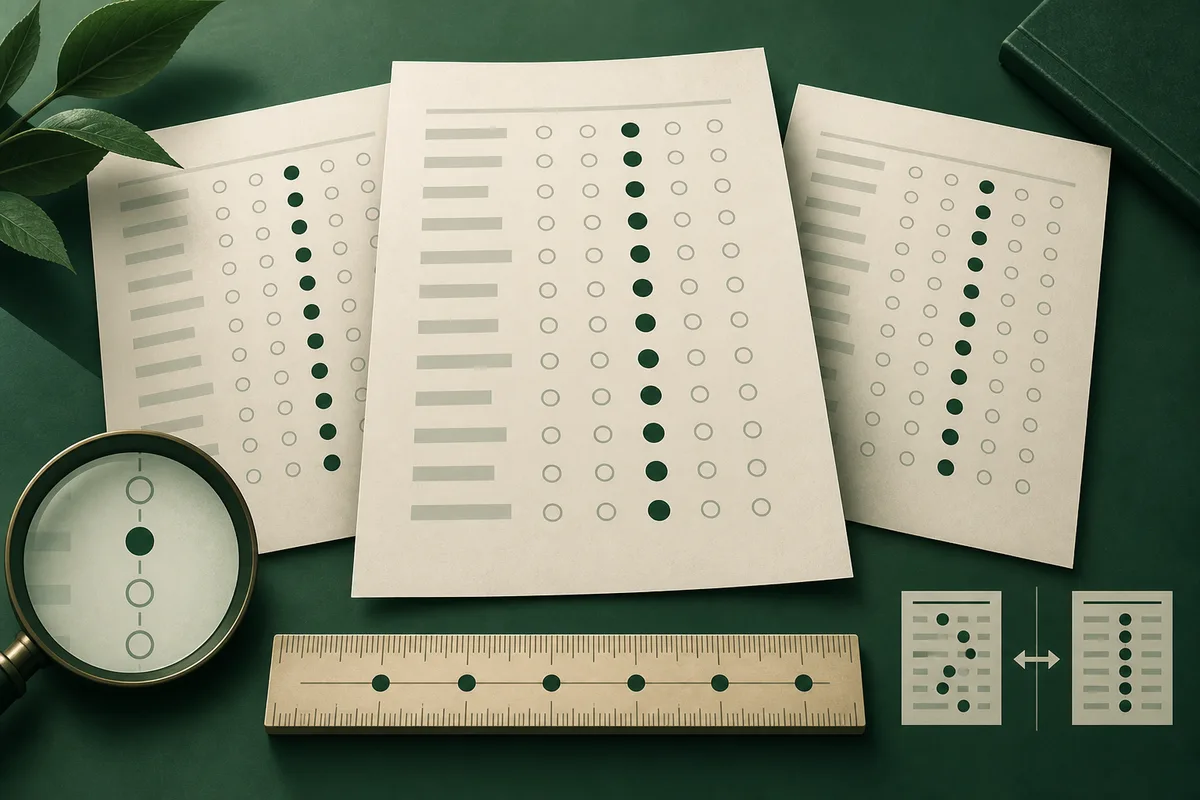
Straightlining is a repeated-answer pattern. In its simplest form, a respondent selects the same choice for a run of items, such as choosing the third option on a five-point scale again and again. Less extreme versions include long strings of identical answers or answers that stay in one narrow part of the scale. The pattern is visible in the response record. The reason for it is not.
That distinction matters in a personality report. A person may use the same answer because several statements genuinely fit to a similar degree. They may also be tired, rushing, distracted, confused by a page layout, responding in a language that is not fully comfortable, or trying to finish a long questionnaire. A response pattern can therefore suggest a question about answer quality without settling the answer.
The research term insufficient-effort responding describes answers given without enough attention to the item content. Straightlining is one possible indicator of it, alongside response time, attention checks, inconsistent answers to related items, and other evidence. Recent work on response quality makes the same conceptual point in more precise language: low-quality responses are observable patterns, while the underlying problem, such as inattention or fatigue, is an inference. Treating the inference as proven can lead to unfair conclusions.
The first decision is consequently modest. Ask whether the report identifies an unusual response pattern and whether it explains its consequences. Do not read a straightlining flag as a personality trait, a diagnosis, or proof of bad faith.
One interpretation: the repeated answers may reflect the items
The first plausible interpretation is that the repeated answers are not automatically invalid. Straightlining is easier to interpret when you know what the item set looks like. A short group of similar statements may invite similar answers. A questionnaire with many items about one narrow facet may also produce a run of responses that is less surprising than a questionnaire mixing different traits and opposite wordings.
The response option itself matters too. Choosing the middle category throughout can mean that the respondent sees the statements as only partly applicable, lacks enough information to choose an extreme, or prefers not to make a strong claim. Choosing one extreme throughout may reflect a real pattern, but it may also indicate that the person stopped processing the content. The visible line does not distinguish these possibilities by itself.
Item direction is another important check. In a balanced scale, some items may describe a tendency in one direction and others may describe its opposite. If someone chooses the same agreement option without reading the wording, the answers can conflict with the intended scoring direction. If all items are worded in the same direction, a straightline detector may have less information with which to identify content-insensitive responding. A report should therefore say what was checked, not merely display a warning label.
This is the first side of the comparison: repeated answers can be a defensible pattern in context. That does not mean the report should ignore them. It means a provider needs more than a visual line to decide whether the resulting score and narrative deserve confidence.
The competing interpretation: answers may not track item content
The second interpretation is that the respondent answered by position rather than by meaning. A person might click the same option down a page after losing concentration. This is often called careless or insufficient-effort responding. The term describes a failure to engage adequately with the questions; it does not establish why that happened or whether it was intentional.
That distinction can affect the report in several ways. If every answer is treated as evidence for a trait, a repeated response can push several raw scores in the same direction. If the questionnaire contains items intended to distinguish different traits, identical answers can make unrelated scales look more alike. If reverse-keyed items are present, the same visible response can contribute differently after scoring, sometimes creating an internally inconsistent profile.
Research using personality scales has found that a limited amount of careless responding can damage the apparent structure of the data. In one study, a model designed to identify inconsistent responses across differently worded items found between 4.4% and 10% of cases in two samples, depending on the scale and sample. The authors reported that trait estimates were more accurate after the identified cases were addressed. Those findings concern study data, not a rule for declaring an individual online report invalid. They show why response quality can change the measurement itself.
The effect is not always in one direction. One investigation of careless responding notes that random answers can weaken relationships among items, while identical answers can inflate relationships and blur distinctions between constructs. The result may be an exaggeratedly tidy profile, an incoherent profile, or a score that looks precise while resting on weak evidence.
How straightlining can reach the written report
An online report usually moves through several layers: selected responses, scored item values, scale totals or averages, any standardized score or percentile, and then a written interpretation. Straightlining can enter at the first layer and travel through every later layer. A polished paragraph does not remove uncertainty introduced by the response record.
Suppose a report combines answers from several items into a broad scale and then compares that result with a reference group. Repeated answers may change the raw total. The provider may transform that total into a standardized score, such as a score expressed relative to a reference distribution, or into a percentile, which describes the proportion of that comparison group scoring lower. The transformation can make the result look more official, but it does not correct a response pattern that failed to reflect item content.
A response-validity section may handle the issue in different ways. It might display a flag, lower confidence in the interpretation, suppress a scale, recommend retesting, or apply a documented scoring rule. There is no instrument-neutral cutoff that can be imported into every online personality test. The threshold should come from the instrument’s documentation and its intended use.
A useful report also separates response quality from the personality conclusion. “The answer pattern was unusually invariant” is an observation. “The result may be less interpretable because content was not consistently considered” is a cautious interpretation. “You are an inattentive person” would be an unsupported leap. The last statement confuses a testing event with a general tendency.
How to judge a straightlining flag without overreacting
Read the flag as part of an evidence bundle. First, find out how it was calculated. Does the provider count the longest run of identical answers, total variation, repeated answers within a scale, or a combination of indicators? A long run across a mixed set of items means something different from a short run within a tightly focused block.
Next, check whether the provider considered item wording and scoring direction. A sound explanation should tell you whether opposite-worded items, attention checks, completion time, missing responses, or consistency indices were used. It should also state what happens when the flag is present. If the report supplies a cutoff without explaining its basis, the number should not be treated as a universal measure of validity.
Then consider the setting. Were the instructions clear? Was the questionnaire completed on a small screen, in a second language, during a break, or while under pressure? These details do not prove that the result is wrong. They explain why a provider should avoid turning one pattern into a judgment about the person. The same caution applies when an accessibility need or reading difficulty may have affected the response process.
Finally, match the conclusion to the use. For private reflection, a flagged report may still provide prompts for checking whether its descriptions fit observable experience, while keeping confidence low. In coaching or development, it may justify discussing the circumstances and gathering other evidence. For selection or high-stakes decisions, a general online report should not carry the decision alone, especially when its response-quality information is opaque. A validity flag is about the report’s evidence, not a license to infer ability, character, or diagnosis.

A practical decision guide before you use the result
If you completed the questionnaire and noticed that you repeated an option, start by reviewing the actual items rather than trying to repair the score by guessing what the test wants. Do not retake it merely to obtain a preferred label. Instead, ask whether you understood each statement, had enough time, and answered about the instructed context, such as typical behavior rather than an unusually good or difficult day.
If the report contains a response-quality flag, look for four pieces of information: what pattern triggered it, which scales it affects, whether the provider considers the result interpretable, and what next step it recommends. If any of these are missing, treat the narrative as provisional. Ask the provider for the instrument documentation or for an explanation in plain language.
For a low-stakes self-reflection exercise, compare the report’s broad descriptions with specific observations from more than one setting. Keep statements that help you ask better questions and set aside statements that depend on a questionable score. For coaching or work, combine the report with relevant conversation, behavior, and performance evidence rather than presenting a straightlined profile as a verdict. A general personality assessment is not a clinical evaluation.
The decision point is simple: use the result when the response process, scoring method, intended use, and uncertainty are clear enough for the decision in front of you. If they are not, pause at the report-reading checklist in the live Personality Report topics library at /topics and seek a better explanation before acting on the narrative.
Questions readers ask
Does straightlining prove that I answered carelessly?
No. It shows repeated answers, not the reason for them. The pattern may reflect similar judgments, a narrow item set, fatigue, confusion, or insufficient attention. A responsible report combines the pattern with item design, other response-quality indicators, and the testing context before deciding how much confidence to place in the result.
Can a straightlined personality report still be useful?
Sometimes, but its use should match the uncertainty. It may offer cautious prompts for private reflection if the report clearly explains the flag. It should not be treated as a precise verdict, and it should not be the sole basis for employment, coaching, or clinical conclusions when the response-quality evidence is unresolved.
Should I retake an online personality assessment after a straightlining warning?
Retesting can be reasonable when the first attempt was rushed, interrupted, misunderstood, or affected by a technical or accessibility problem. Do not retake it simply to change an unwelcome result or to learn how to produce a preferred profile. Follow the provider’s documented retest guidance and compare results with attention to measurement uncertainty.
Sources and notes
- A little garbage in, lots of garbage out: Assessing the impact of careless responding in personality survey data
Supports the finding that insufficient-effort responses can damage personality-scale structure, reliability, and trait-estimate accuracy.
- Careless Responding Threatens Factorial Analytic Results and Construct Validity of Personality Measure
Supports the distinction between random and identical responding and their different effects on item relationships and construct interpretation.
- The Differential Impacts of Two Forms of Insufficient Effort Responding
Supports the definition of straightlining as insufficient-effort responding and the caution that no detection method is perfect.
- 16pf Sixth Edition Technical Manual
Provides an instrument-specific example of reviewing response-style indices before interpreting personality scales and generating hypotheses rather than diagnoses.
- A unified framework for characterizing response quality in surveys with multi-item scales
Supports separating observable response patterns from unobserved causes and treating response-quality indicators as fallible evidence.
Apply it to your work
Understand how you work before you choose what comes next.
From this guide: Carry this report-reading question into the work decision in front of you.
Build a private Work Pattern Report across ten workplace continuums, then compare the result with the demands of the role or environment in front of you.