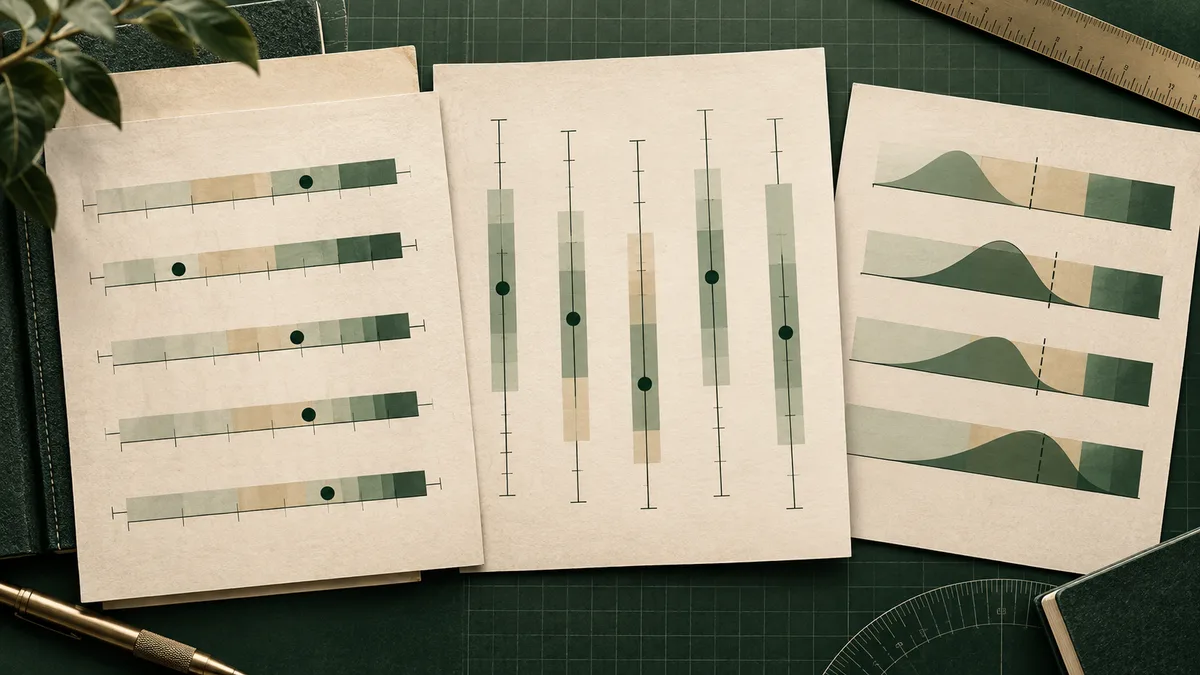
Personality report cutoffs are sometimes useful and sometimes merely convenient. A cutoff is a chosen boundary that turns a range of scores into labels such as low, typical, or high. It can summarize a norm-referenced position, support a clearly defined decision, or make a report easier to read. It does not, by itself, show that people just below and just above the line are meaningfully different. The sensible question is not whether a cutoff is real in the abstract. Ask what the boundary was designed to mean, which comparison group or criterion supports it, how precise the score is near the boundary, and what decision you are about to make from it.
The claim under review: a label marks a real change
A report may place a continuous personality score into three or five bands. The visual result feels definite: one person is described as high, another as average, and a third as low. That format is easy to scan, especially when a reader wants a plain-language summary. The label can be useful as a signpost. It becomes misleading when it is treated as a discovery of a sharp boundary in the person.
A cutoff is a rule for classification, not a physical edge in a personality trait. A trait score usually represents a position on a measurement scale, with people spread across a range. The report adds a boundary so that the scale can serve a particular purpose. The same score can therefore receive different labels under different norms, instruments, or reporting rules. A label is meaningful only in relation to that underlying design.
The strongest conclusion is modest: cutoffs can organize information, but their meaning must be earned by the report's measurement model and intended use. Without that information, treat a band as a rough description, not a verdict about character, ability, or future behavior.
First identify what the boundary is comparing
Look for the report's score type before interpreting a band. A raw score is the total produced by the instrument's scoring rules. It may be a sum, average, or transformed value, and its number has no general meaning outside that instrument. A standardized score expresses the position of that raw score on a stated scale. A percentile rank describes the percentage of people in a defined norm group who scored lower, or the relative standing according to the publisher's precise convention.
A norm-referenced cutoff answers a relative question: where does this score sit compared with a specified reference group? The comparison might be with a general adult sample or another population chosen by the test developer. The label does not mean that a trait reaches an ideal level. It means that the score falls in a particular part of that distribution. The reference group matters because changing it can change the percentile or band without changing the person's responses.
A criterion-referenced cutoff answers a different question: does the score correspond to a defined level of performance or another criterion? That kind of boundary requires evidence linking the score to the criterion and to the proposed use. A report that quietly presents a norm-based label as if it were an absolute standard is asking the score to do more work than its evidence supports.
Why convenient categories can distort a continuous score
Categories compress information. Imagine a report that labels a scale low below a boundary, typical in the middle, and high above another boundary. Two hypothetical readers whose scores fall on opposite sides of the first boundary may be almost identical on the original scale, yet the report presents them as different types of reader. Meanwhile, two people at opposite ends of the same broad band may receive the same label despite a larger score difference.
This is not an argument against every band. It is a reason to keep the underlying score visible and to avoid treating the label as a complete description. Research on categorizing continuous variables has identified information loss, exaggerated differences near a boundary, and added problems when the original measurement contains error. It also finds that different cut points can create different trade-offs across relationships and contexts, so one set of boundaries is rarely objectively best for every purpose.
The practical translation is simple: read a category as a range. Ask where the score sits inside that range, whether adjacent bands overlap in their uncertainty, and whether the report explains why those boundaries were selected. A convenient label may still be a helpful summary. It is not evidence that the underlying trait changes abruptly at that number.
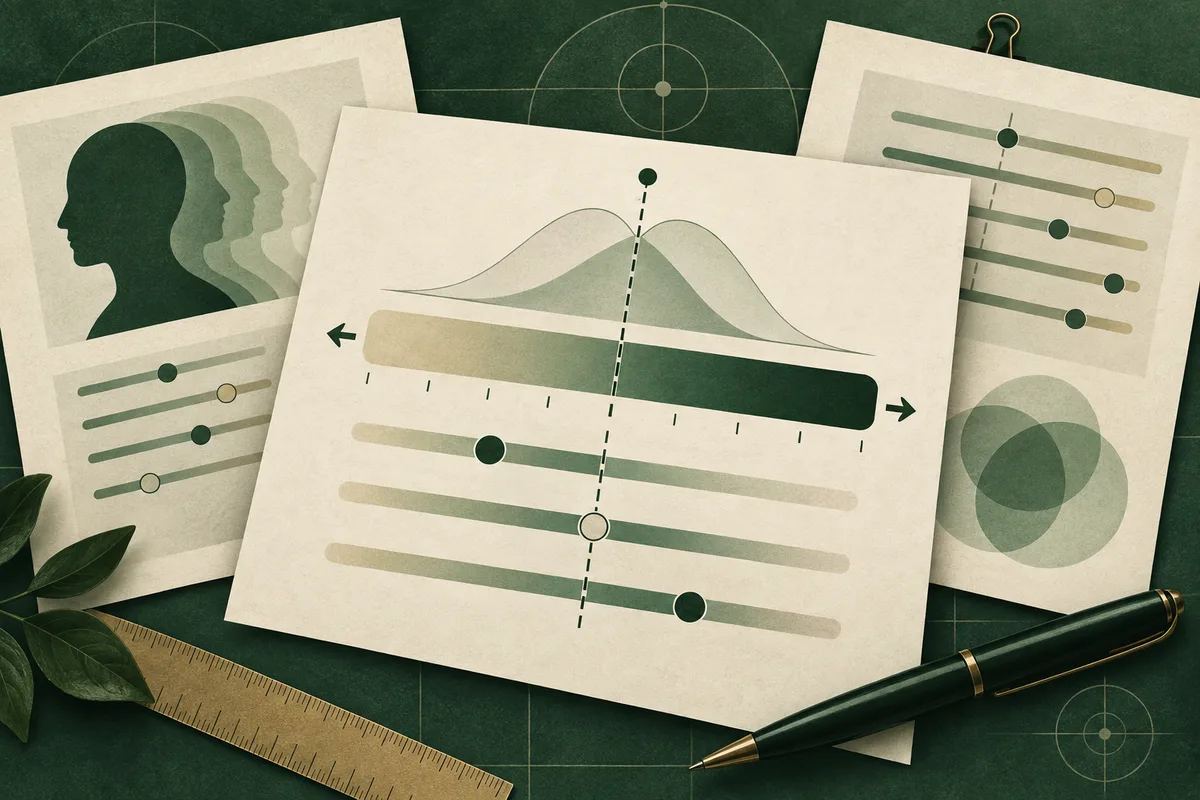
A worked reading of a banded report
Consider an example. A report shows a scale score, a percentile, and the word “high.” Its legend says that scores above a stated boundary receive that label. The first question is not, “How high is high?” It is, “High compared with whom, and for what purpose?” If the percentile is norm referenced, the label summarizes relative standing in that norm group. It does not establish a universal amount of the trait or predict how the reader will act in every setting.
Next, inspect the distance from the boundary. A score comfortably inside a band may support a clearer descriptive statement than a score sitting on its edge. Even then, the description should remain bounded: the score suggests a tendency on the measured construct under the conditions of the assessment. It does not prove a stable identity, a skill, a weakness, or a cause of a particular behavior.
Finally, compare the report's wording with its evidence. “Scored relatively higher than much of the norm group” is a narrower claim than “will excel at collaboration.” The first may follow from a norm table. The second requires separate evidence for a behavior and a context. The Standards for Educational and Psychological Testing emphasize that validity belongs to a proposed interpretation for a specified use, not to a test in the abstract.
The boundary is least certain near the boundary
Every assessment contains some measurement error. Here, error means the observed score is not a perfectly exact reading of the person's standing on the construct at that time. Sources can include item sampling, response interpretation, administration conditions, and temporary context. The amount and form of error depend on the instrument, not on a universal rule for all personality reports.
If a score is close to a cutoff, a small amount of ordinary uncertainty may move its classification from one band to the next. The underlying tendency has not necessarily changed in the same dramatic way. A careful report may provide a confidence interval, a standard error of measurement, or guidance for interpreting scores near a boundary. If it does not, the reader should resist drawing a fine distinction from a narrow numerical difference.
This is why a report that gives only a category can be less informative than one that shows the score, the norm or criterion, the band definition, and an uncertainty estimate. The category answers a quick sorting question. The fuller display helps the reader judge how much confidence that sorting deserves.

When a cutoff earns more trust
A cutoff is more defensible when its purpose is explicit and its evidence matches that purpose. For a norm-referenced description, the report should identify the norm population, explain the score conversion, and show that the norms are appropriate and sufficiently current for the intended interpretation. A publisher should also explain the labels rather than making readers infer that “high” means desirable.
For a decision rule, the boundary needs more than a familiar percentile or a neat round number. It should be connected to a defined criterion, a stated consequence, and evidence about classification accuracy and fairness in the relevant population. The testing standards note that arbitrary cut scores have little meaning without information about the test, the requirements, and their relationship. They also caution that misclassification is generally more likely for scores close to a cut score.
The stakes change the reading. A broad band may be adequate for self-reflection or a coaching conversation when it opens a question for discussion. The same band is not automatically adequate for selecting applicants, making a clinical judgment, or denying an opportunity. Those uses require evidence for the specific inference and safeguards against overreading a single score. A general personality report is not a diagnosis.
A practical cutoff checklist
Before acting on a personality report category, check these points:
1. Name the score. Is it raw, standardized, a percentile, a facet score, or a band derived from one of these? Do not compare numbers from different instruments as if they share a scale.
2. Name the comparison. If the report is norm referenced, who is in the norm group? If it is criterion referenced, what defined criterion does the boundary represent?
3. Find the rule. Does the report explain why the cutoffs were chosen, or do they look like unexplained convenient divisions? A round number is not evidence by itself.
4. Check the edge. Is the score near a boundary? Look for a standard error, confidence interval, or cautious language. If the classification could change with ordinary uncertainty, describe it as borderline rather than decisive.
5. Match the claim to the evidence. Use a score to ask about a measured tendency. Do not turn it into a diagnosis, moral judgment, fixed identity, or unsupported prediction about work or relationships.
6. Choose a next step. For self-reflection, write one observable situation that might test the report's description. For coaching, discuss context and exceptions. For a consequential decision, require independent evidence and an instrument validated for that exact use.
The decision point is therefore clear. Keep the cutoff when it helps you navigate the report and its stated purpose. Set it aside when it encourages a sharp conclusion that the score, norms, uncertainty, and evidence cannot support. For more assessment-literacy guidance, continue with the live topics library.
Questions readers ask
Does crossing a personality report cutoff mean my personality changed?
Not necessarily. A small change in an observed score, response context, or measurement uncertainty can move a result across a reporting boundary. Read the score, its uncertainty, and the band definition together before concluding that the underlying tendency changed.
Should I trust a low, average, or high label more than the number?
Usually, the label is a summary of the number under a particular norm or reporting rule. Trust it only to the extent that the report explains the comparison group or criterion, supports the intended use, and handles uncertainty near the boundary.
Sources and notes
- Standards for Educational and Psychological Testing
Supports distinctions between norm- and criterion-referenced interpretations, cutoff use, norm quality, validity for specified uses, and uncertainty near boundaries.
- APA Dictionary of Psychology: Norm-referenced test
Defines norm-referenced interpretation as comparison with a norm from a specified group.
- Cut points and contexts
Supports the argument that categorizing continuous variables loses information and that no single set of cut points is objectively best across contexts.
- Estimating meaningful thresholds for multi-item questionnaires using item response theory
Supports distinguishing a meaningful threshold tied to an external state from a convenient division of a continuous questionnaire score.
Apply it to your work
Turn ‘that job was not for me’ into something more useful.
From this guide: Keep a band as a cautious summary for reflection; do not use it as a decisive judgment when the report cannot explain its boundary or uncertainty.
The Work Pattern Report can help you separate repeated preferences from one difficult environment by mapping ten work continuums and their intersections. Compare the pattern with the role’s pace, planning, feedback, conflict, ownership, and change demands without reducing the experience to personality alone.